Queen Victoria Market is the best place in Melbourne to start your day hungry and curious. Locals call it Queen Vic, or just QVM, and they have shopped here since 1878. It is a working food market first and a tourist stop second, which is exactly why it feels so alive. You will find fresh produce, cheese, meat, seafood, hot food, clothes and gifts spread across seven hectares of old sheds and halls at the northern edge of the city centre. This guide covers what to see in each hall, what to eat, when to go, how to get there, and how to make the most of a morning here.
Why Queen Vic Is Worth Your Morning
Most Melbourne attractions show you the city. This one lets you taste it, hear it and join in. Traders call out prices, shoppers haggle over nothing but compare everything, and the smell of fresh bread mixes with coffee and hot jam donuts. It is loud, busy and a little chaotic on a Saturday, and that is the point.
It is also free to enter, easy to reach by tram, and close to the city centre. You can spend an hour here or half a day. A quick visit still gives you the halls, a hot snack and a feel for the place. A slow visit gives you a picnic, a bag of groceries and a few stories to take home.
Families, food lovers, photographers and first-time visitors all get something different from the same sheds. Kids love the donuts and the noise. Cooks love the produce prices. History lovers get a site that has traded on the same ground for nearly 150 years. And if you only have time for one market in Melbourne, this is the one to pick.
What You’ll Find Inside the Market
The market covers about seven hectares across two city blocks, between Elizabeth, Victoria, Peel and Franklin Streets. It is split into halls and open sheds, and each part has its own job. The food halls sit under cover. The produce sheds are open-sided. The general merchandise sheds run along Elizabeth Street. A first visit can feel big, so it helps to know what lives where before you arrive.
The Deli Hall
The Deli Hall is the place to start. It sits in the old Dairy Produce Hall, an art-deco building with tall windows and long glass counters. Inside you will find cheese mongers, cured meats, olives, antipasto, fresh pasta, bread and prepared foods. Many stalls are run by families who have traded here for decades.
Take your time here. Most cheese sellers offer free tastings, so you can try before you buy. Ask what is good right now and the trader will tell you straight. This is where you build a picnic: a wedge of cheese, some salami, a loaf of sourdough and a tub of olives. Prices are fair and the quality is high, which is why locals do their weekly shop in this hall.

The Meat and Fish Halls
The Meat Hall on Elizabeth Street dates from 1869, nine years before the market officially opened. It is the oldest building on the site. Inside, dozens of butchers sell lamb, beef, pork, poultry and game. You will also see kangaroo and emu at some stalls, which surprises plenty of first-time visitors.
Next door, the Fish Hall sells the day’s catch. Expect King George whiting, Tasmanian salmon, prawns, snapper, flathead and Coffin Bay oysters. Some stalls shuck oysters to order. If you are staying in an apartment with a kitchen, this is a good place to buy dinner. If you are just looking, walk through slowly and watch the traders at work. The halls are cool, busy and full of noise, and they show you the market at its most old-fashioned.
The Produce Sheds
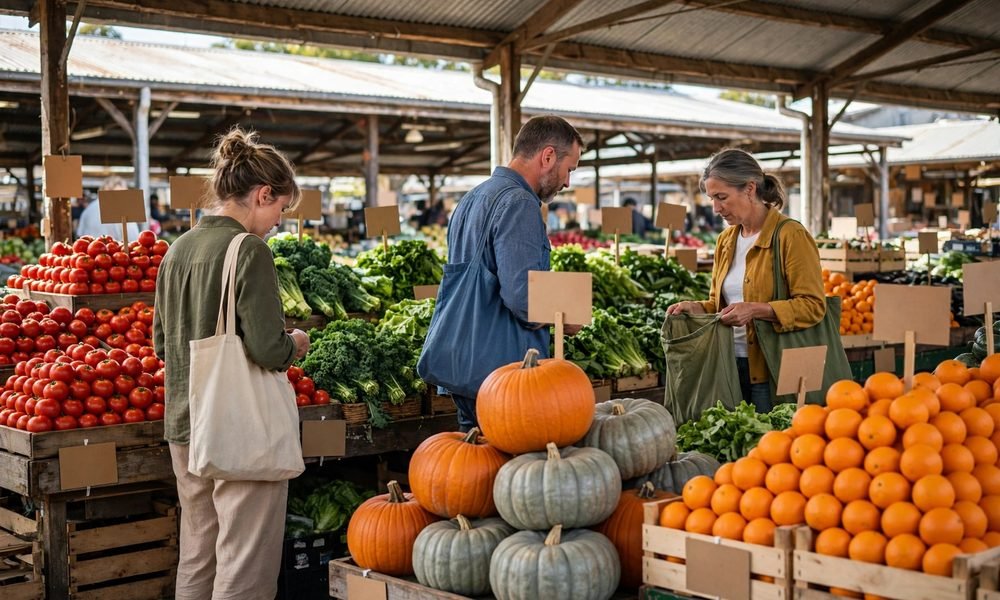
The open-sided produce sheds hold row after row of fruit and vegetables. Stallholders mark prices by the kilo or by the piece on handwritten cards. Stock comes in daily from Victorian farms, so what you see depends on the season. Strawberries arrive from Bacchus Marsh, apples from the Yarra Valley, asparagus from Koo Wee Rup and tomatoes from the Werribee market gardens.
Come early for the widest choice. By late morning the best stock starts to thin out. Come late and you get the bargains instead: traders mark produce down in the last hour before closing. If you see something you like, buy it. The same stall may not have it next week, and prices vary between sheds, so a quick look around before you buy can save you a few dollars.
Queen’s Food Hall
Queen’s Food Hall sits on the corner of Victoria and Queen Streets, where the old food court used to be. This is where you sit down and eat. Stalls serve hot food from around the world: Vietnamese pho, dumplings, Turkish gozleme, Spanish bocadillos, Polish bratwurst and Japanese takoyaki. Most mains cost around $10 to $18.
Seating can be hard to find at lunchtime on a Saturday, so grab a table when you see one. A good move is to buy small plates from two or three stalls instead of one big meal. That way you taste more of the market. Coffee stalls are scattered through the halls too, and a flat white from a market cafe is a fine way to start the morning.
String Bean Alley and the General Merchandise Sheds
String Bean Alley is a narrow laneway of small traders selling jewellery, leather goods, ceramics, small fashion labels and gifts. It is quieter than the food halls and worth a slow wander. The general merchandise sheds nearby sell clothing, footwear, kitchenware, souvenirs, homewares, cosmetics and toys.
Quality varies more here than in the food halls, so look closely before you buy. Some stalls sell great local designs. Others sell the same souvenirs you will see in every tourist shop in the city. If you want a gift, check a few stalls first and compare prices. Specialty shopping opens at 9am on market days, so the merchandise sheds are quiet before then.
The Foods You Have to Try
You could visit the market and buy nothing but still leave full. Tastings in the Deli Hall, samples at the produce stalls and the smell of hot food everywhere make it hard to walk past without eating. These are the foods visitors talk about most, and they are all easy to find.
The Famous Jam Donuts
The American Doughnut Kitchen sells hot jam donuts from a converted caravan, and they are the market’s most photographed food. The donuts are rolled in cinnamon sugar and filled with hot raspberry jam. They cost around $8 for five. The queue moves fast, so join it even if it looks long.
Eat them straight away while they are still warm. They are messy, sweet and simple, and they have been a market ritual for years. If you only try one thing at the market, make it these. There is also a second donut stall, Olympic Doughnuts, which sells Greek-style ring donuts if you want to compare.
Borek, Bratwurst and Dumplings
For a savoury lunch, start with a borek. The Borek Stall sells Turkish pastries filled with spinach and feta or spicy lamb. They are hot, filling and cheap. The Bratwurst Shop sells Polish-style sausages that have been a market staple for years. Dumpling stalls and pho stalls in Queen’s Food Hall are good when you want something warm and quick.
None of this food is fancy, and that is the charm. You eat standing up or at a shared table, surrounded by shoppers. If you are unsure what to order, watch what the locals are eating. The busiest stall is usually the best bet.
Cheese, Smallgoods and Picnic Supplies
If you want to eat later, shop the Deli Hall instead. Andrew’s Choice is a long-running Italian deli with a wide cheese range, salami, prosciutto and fresh pasta. King Island Dairy sells Tasmanian cheeses, and the brie and washed-rind are worth trying. La Latteria sells fresh Italian cheeses like bocconcini, ricotta and burrata.
Pair your cheese with sourdough from Phillippa’s Bakery and olives from a Mediterranean stall. Add fruit from the produce sheds and you have a picnic for two for not much money. Royal Botanic Gardens Melbourne is a short tram ride away if you want a green spot to eat it, or head to Flagstaff Gardens, a few blocks south-west of the market.
A First-Timer’s Walking Route Through the Market
The market is big enough to get lost in, so a simple route helps. Start at the Elizabeth Street entrance, near the corner of Victoria Street. This puts you at the general merchandise sheds first. Have a quick look, but do not buy anything yet. Your hands will be full soon enough.
Walk into the Meat and Fish Halls next. They sit along Queen Street and they are worth seeing while they are still busy and full. Take your time here, watch the traders, and buy any seafood or meat you need for dinner. Then cross to the Deli Hall. This is your slow stop. Taste cheese, buy smallgoods and bread, and pick up picnic supplies.
From the Deli Hall, head out to the open produce sheds along Victoria Street. Buy fruit and vegetables last, since they are the heaviest part of your shop. Finish at Queen’s Food Hall for lunch, then join the donut queue on your way out. The whole loop takes about two hours at a relaxed pace, including lunch. If you only have one hour, skip the merchandise sheds and start in the Deli Hall.
A few habits make the walk easier. Bring a reusable bag, since single-use plastic bags are banned in Victoria. Wear walking shoes, because you will be on your feet the whole time. Keep cash in your pocket for the smaller stalls, even though most traders take cards. And if a trader offers you a taste, take it. That is how the market works.
The Story of the Market
The market officially opened on 20 March 1878, but the site’s story starts earlier. The Meat Hall was already standing in 1869. The market grew out of a reserve set aside in 1857, and the lower market was used for livestock and hay from 1865. The sheds you see today mostly date from the late 1800s, and ten of the twelve historic sheds have now been restored.
What makes the market special is that it never stopped being a working market. It survived wars, downturns and decades of redevelopment plans. In 2018 it was added to Australia’s National Heritage List, which recognised its links with Melbourne’s early colonial population and its role as a surviving metropolitan produce market. It is the only major 19th-century market in Australia to survive intact and still trade.
The Cemetery Under the Car Park
Part of the market sits on Melbourne’s first official cemetery, which took burials from 1837 to 1854. Around 10,000 people are thought to have been buried there, including some of the city’s earliest European settlers and members of the Wurundjeri Woi-wurrung and Bunurong peoples of the Kulin Nation. The records were lost in a fire in 1864, so the exact number is not known.
When the market expanded, most graves with monuments were moved. Between 1920 and 1922, 914 bodies were exhumed and reburied elsewhere. But many remains still lie beneath the open-air car park and some of the sheds. F Shed was built in 1878 as a barrier between the market and the remaining cemetery ground. A heritage memorial near the Queen Street entrance marks this history, and the market’s free self-guided heritage trail includes a stop beside the old cemetery ground on Peel Street.
How Melburnians Saved the Market
In the early 1970s the city council planned to redevelop the site. Locals pushed back hard. By February 1972 about 18,000 people had signed against the plans, and the redevelopment was shelved in 1975. Chinese, Greek and Italian market gardeners had played a large part in the market’s trade, and the market kept its retail trade even after the wholesale market moved to Footscray in 1969.
The fight mattered because it kept the market in local hands. Prices, produce quality and stallholder relationships are still shaped by a real local customer base that shops here every week. That is why the market still feels like a working place rather than a show put on for visitors. Renewal works continue today, with heritage restoration and new public space planned as part of Gurrowa Place. The open-air car park is set to become a public square called Market Square, though not before about 2028. H and I Sheds are restored but stay closed until a new Trader Shed is finished, and their traders have moved to C and D Sheds for now.
Opening Hours and the Best Time to Visit
The market trades five days a week. It is closed on Mondays and on Wednesdays during the day, which catches plenty of visitors out. Always check the market’s own website before a special trip, since hours can shift around public holidays. The market closes on most public holidays, including Melbourne Cup Day and Easter Saturday.
| Day | Market hours | Specialty shops |
|---|---|---|
| Tuesday | 6am to 3pm | From 9am |
| Wednesday | Closed by day; night market 5 to 10pm in season | Closed by day |
| Thursday | 6am to 3pm | From 9am |
| Friday | 6am to 3pm | From 9am |
| Saturday | 6am to 4pm | From 9am |
| Sunday | 9am to 4pm | From 9am |
| Monday | Closed | Closed |
The Best Day and Time to Visit
Saturday morning around 9am is the classic market visit. It is busy, loud and full of weekend energy. If you like crowds and atmosphere, that is your day. If you prefer a calmer visit, come on a Tuesday or Thursday morning. The market’s own guidance puts the quietest hours at 7am to 11am on weekdays, outside school holidays.
Friday sits in the middle. It has the working food market feel of a weekday with a livelier visitor crowd. Sunday starts later at 9am and feels more relaxed, with Queen Street partly closed to traffic so pedestrians get more room. For the cheapest produce, visit in the last hour before closing, when traders mark down stock. For the freshest choice, arrive at opening.
What to Expect in Each Season
Summer brings the widest range of stone fruit and the liveliest atmosphere, plus the Wednesday night market season. The open produce aisles can get hot at midday, so come early and bring water. Autumn is milder, with mushrooms and apples in season and smaller crowds. Winter is the quietest time, with citrus in season and heartier hot food drawing people into the covered halls.
Spring brings asparagus and the first stone fruit, and crowds start to build toward summer. Whatever the season, Melbourne’s weather can turn fast, so check the forecast and dress in layers. Most of the market sits under permanent roofing, but the open produce aisles are exposed. A light rain jacket beats an umbrella here, since the aisles get tight on a busy day.
How Much Money to Bring
Entry is free, so your budget is just food and shopping. A morning of eating your way around the market costs less than a cafe brunch. Plan on around $10 to $18 for a hot lunch in Queen’s Food Hall, $8 for five jam donuts, and a few dollars for coffee. A picnic of cheese, bread, smallgoods and fruit for two people usually comes to $25 to $40, depending on what you pick.
If you are grocery shopping, bring more. Produce prices are often lower than CBD supermarkets, and the last-hour markdowns can be steep. Most stalls take cards, but some smaller traders prefer cash or add a small card surcharge. A mix of card and a little cash covers you. There is no need to bargain. Prices are marked and fixed, and haggling over a marked price is not part of how this market works. The only exception is near closing time, when some traders may offer a small discount on what is left.
The Wednesday Night Market
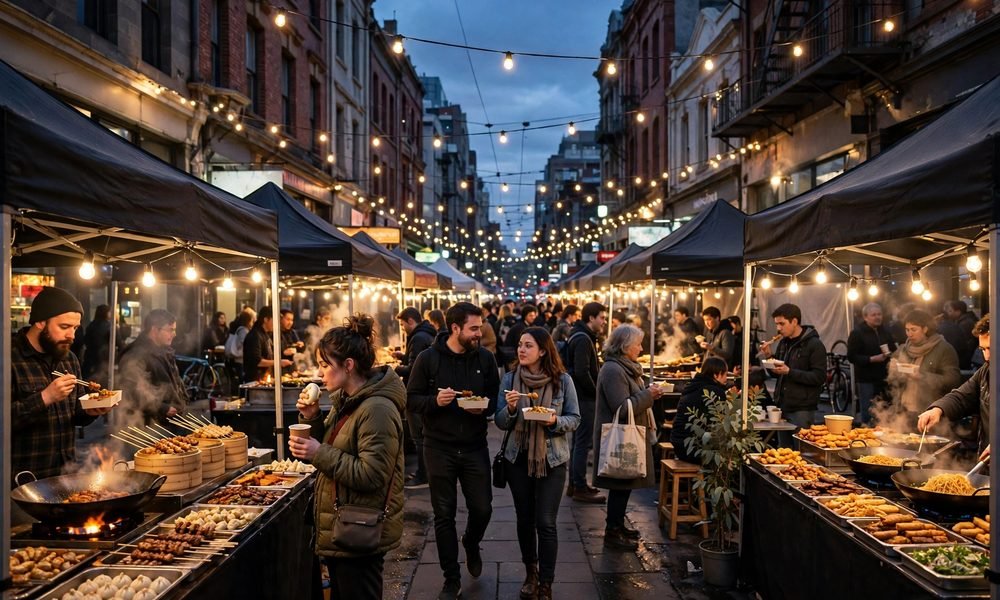
On Wednesday evenings in season, the market changes completely. The day stalls close and the sheds fill with street food vendors, pop-up bars, artisan stalls and live music. It runs from 5pm to 10pm and entry has been free in past seasons. It is a different experience from the day market, and it suits an evening out more than a grocery shop.
The night market runs in seasonal blocks. The Winter Night Market ran on Wednesdays from June to September in 2026, with mulled wine, hot stews and live music indoors. The Christmas Night Market runs on Wednesdays from late November to mid-December, and the Summer Night Market runs on Wednesdays from early January to early March. Dates change each year, so check the market’s website or thenightmarket.com.au before you plan around one.
Arrive early for the widest food choice, since the most popular stalls sell out. The market is busiest between 6.30pm and 8pm, so coming at 5pm or after 8.30pm is calmer. It is family-friendly until around 8pm, then the crowd turns younger and more focused on drinks. Seating is limited, so expect to stand and eat. Themed nights rotate through the season, with Mexican, Asian street food and Polish heritage nights among the past themes.
Food Tours, Cooking Classes and the Free Heritage Trail
A guided food tour is the fastest way to learn the market. The market’s own Ultimate Foodie Tour runs for about two hours, with tastings, trader introductions and history, in groups of about ten. Prices sit around $95 to $110 per adult, with a lower child price, and booking ahead is essential. Other operators run tours too, including Foodie Trails and Hidden Secrets Tours, which mix history with tastings.
If you would rather explore alone, download the free self-guided audio tour from the market’s app. It is available in English, Mandarin, Japanese, French and Spanish. The market also publishes a free self-guided heritage trail leaflet with eleven stops. It turns a market morning into a walk through the buildings and the cemetery history. One stop, the organic aisle in I Shed, sits inside a shed that is now closed, but the rest can be seen on any market day. Free heritage tours run on selected weekends, and you can book through the market’s website.
For something hands-on, the market’s cooking school runs classes for around $140 to $180 per person, usually about two hours. Wine and cheese pairing classes run from time to time as well. School holiday programs include themed scavenger hunts for kids, which give younger visitors a reason to explore the sheds with a purpose.
Getting to the Market
The market sits at the corner of Elizabeth and Victoria Streets, on the northern edge of Melbourne‘s CBD. It is inside the Free Tram Zone, so a tram ride there costs nothing if your whole trip stays inside the zone. Driving is possible but rarely the easiest option, especially on a Saturday morning.
By Tram and Train
Trams 19, 57 and 59 run along Elizabeth Street and stop right at the market. Tram 58 runs along Peel Street on the western side. All stops near the market are step-free. Melbourne trams are free inside the city centre zone, but check the stop signs, since the market sits near the northern edge of the zone. Travel past the boundary needs a valid fare.
By train, Melbourne Central Station is about a seven-minute walk south, and Flagstaff Station is a similar walk to the east. From Melbourne Central, use the Elizabeth Street and La Trobe Street exit and head north up Elizabeth Street. From Flinders Street Station it is a longer walk straight up Elizabeth Street, around 10 to 15 minutes. If you are flying in, our Melbourne Airport guide covers the trip into the city.
By Car and Parking
Two car parks serve the market, both entered from Queen Street. The undercover car park is open 24 hours a day, and the open-air car park opens from 5am to 7pm. On market days, parking is free from 6am to 9am. After 9am it costs $8 for the first two hours and $4 for each extra hour, with a $40 daily maximum. On Wednesday night market evenings, a separate $15 rate applies after 2pm.
On Mondays and Wednesdays during the day, rates start at $4 for one hour. Evening entry after 4.30pm costs $12, with set exit times, so check the signs at the entry for the rate that applies to your visit. Disability parking bays sit at all entrances, and there is lift access from the undercover car park to the Deli Hall. Bike racks stand at all main entrances, and the market sits on the Capital City Trail.
Where to Stay Near the Market
Staying near the market means you can walk there for an early start and carry your shopping home easily. The northern end of the CBD, around Melbourne Central and Flagstaff, puts you within a ten-minute walk. Carlton and North Melbourne are also close, with Carlton’s Lygon Street a short tram ride east for dinner once the market closes.
If you want help picking a place, our best hotels in Melbourne guide lists named picks by budget and area, and our where to stay in Melbourne guide explains the best areas in plain terms. The market area suits travellers who like to self-cater, since you can buy breakfast and picnic supplies here each morning and cook in your apartment.
A Half-Day Plan: The Market and the Streets Around It
The market pairs well with the streets around it, and a half day is enough to cover both. Start with coffee in one of Melbourne’s laneways, then walk north up Elizabeth Street to the market for a two-hour visit and lunch. After lunch, walk south to the Federation Square area, or east to Carlton and Lygon Street for an Italian dinner.
Other easy stops nearby include the State Library Victoria, a grand reading room and gallery a short walk south, and Flagstaff Gardens, the nearest green space for a picnic. Chinatown on Little Bourke Street is close too, and it pairs well with a market morning if you want dumplings for a second lunch. If you are planning a longer stay, our things to do in Melbourne guide and our free things to do in Melbourne guide will help you fill the rest of your days. The market also works as a starting point for day trips from Melbourne if you want to get out of the city after your shop.
Visiting the Market With Kids
The market works well for families. Entry is free, the aisles are wide, and there is always something small and cheap to eat. A jam donut, a piece of fruit or a small treat from the Deli Hall makes an easy reward for kids who walk the sheds with you. The market runs school holiday programs with themed scavenger hunts, which give kids a job to do while you shop.
Come on a weekday morning if you can. Saturday crowds make pushing a pram through the busiest aisles slow work, and the Deli Hall gets packed by mid-morning. Parents’ rooms with feeding chairs and changing tables sit at the Queen Street main entrance, and public toilets are spread across the site. Keep younger children close in crowded aisles, and plan a rest stop. Seating is scarce at lunchtime, so a picnic in Flagstaff Gardens is often easier than finding a table. Our Melbourne with kids guide has more ideas for family days in the city.
Accessibility, Dogs and Other Practical Details
Much of the market is wheelchair accessible. The Meat and Fish Hall and the Dairy Produce Hall have flat surfaces and step-free entry from Elizabeth and Queen Streets. The open sheds have mostly flat bitumen surfaces, though the site slopes gently down from Peel Street toward Elizabeth Street, and outdoor surfaces can be uneven in wet weather. Accessible toilets and accessible parking are available, and there is lift access from the undercover car park.
You can borrow a wheelchair for free from the Information Hub at F Shed Shop 1, on the Queen Street corner. Loans are first come, first served and cannot be booked. The Information Hub opens from 9am to 3pm on Tuesday, Thursday and Friday, and from 9am to 4pm on Saturday and Sunday. Staff there can help with maps, directions and the most accessible route between sheds. Assistance animals are welcome throughout the market, and the Companion Card is recognised for tour pricing.
Dogs are welcome on leads in the outdoor sheds, though some food traders have rules about dogs near food displays. Service animals can go everywhere. Free Wi-Fi covers most of the market. Public toilets sit at several points across the site, and parents’ rooms are at the Queen Street entrance. The market also runs sensory-friendly mornings from time to time, which are quieter sessions for visitors who find crowds hard.
Wet Weather at the Market
A wet day still works here. The Deli Hall, Meat Hall, Fish Hall and general merchandise sheds are all fully covered, and only the open produce aisles along Victoria Street get properly wet. Wear a light rain jacket rather than carrying an umbrella, since an open umbrella is awkward in tight aisles on a busy day.
Rainy visits are often quieter than sunny Saturdays, which can work in your favour if you want a relaxed browse. The covered halls feel cosy in bad weather, and the hot food stalls do a brisk trade. Just take care on wet surfaces in the open sheds, and keep your shopping bags dry if you are buying paper-wrapped goods.
Souvenirs and Biosecurity: What International Visitors Should Know
The market is a good place to buy gifts to take home, but Australia’s biosecurity rules limit what you can carry out of the country. You cannot take meat, dairy, fresh produce or honey out of Australia. Buy those for eating while you are here, not for your suitcase.
Some gifts travel well. Tasmanian leatherwood honey is a popular souvenir and is generally allowed. Australian wine, olive oil and dried goods are usually fine in checked baggage with declarations. Wattleseed and other bushfood pantry items are generally export-friendly too. Coffee beans are fine to export. If you are unsure about an item, ask the trader before you buy, and always check your destination country’s biosecurity rules as well.
For gifts that are safe to pack, look at the general merchandise sheds and String Bean Alley. Locally designed jewellery, leather goods, ceramics and homewares make better souvenirs than the mass-made items you will see repeated at stall after stall. The shops along Victoria Street sell cookbooks and kitchenware, which also pack well and suit food lovers.
Queen Vic or South Melbourne Market?
Melbourne has two famous markets, and visitors often ask which one to pick. Queen Vic is much larger, at seven hectares, and more central. It is also more touristy, with bigger crowds and a wider mix of food and general merchandise. South Melbourne Market is smaller, more upscale, and has a stronger focus on prepared food and gourmet items.
If you only have time for one market, pick Queen Vic. It gives you the history, the scale and the full working-market feel in one visit. If you have a longer stay, add South Melbourne Market as a second stop. It is quieter, easier to browse, and worth a visit if you want a less crowded market day. The two markets suit different moods, and neither is a bad choice.
FAQs About Visiting the Market
What days is the market open?
The market trades Tuesday, Thursday, Friday, Saturday and Sunday. It is closed on Monday and Wednesday during the day, apart from seasonal night markets on Wednesday evenings. Check the market’s website before a special trip, since hours can change around public holidays.
What are the opening hours?
Tuesday, Thursday and Friday from 6am to 3pm, Saturday from 6am to 4pm, and Sunday from 9am to 4pm. Specialty shopping opens from 9am on market days. The night market runs from 5pm to 10pm on its Wednesdays in season.
Is entry free?
Yes. There is no admission fee. You pay only for what you eat and buy, for parking after 9am on market days, and for any tour or class you book.
How long should I spend there?
Allow one hour for a quick look at the main halls and sheds, or two to three hours for a first visit with food and shopping. A half day suits visitors who want to browse every shed, follow the heritage trail or combine the market with nearby attractions.
What is the best day to visit?
Saturday morning around 9am has the liveliest atmosphere. Tuesday and Thursday mornings are quieter and better for relaxed shopping. Friday offers a balance of the two. The last hour before closing is best for produce markdowns.
How do I get there?
Trams 19, 57 and 59 stop at the market on Elizabeth Street, and tram 58 stops on Peel Street. The market sits inside the Free Tram Zone. Melbourne Central and Flagstaff stations are each about a seven-minute walk away.
Is there parking?
Yes. Two car parks sit on Queen Street, one undercover and one open-air. Parking is free from 6am to 9am on market days, then $8 for the first two hours and $4 for each extra hour, with a $40 daily maximum.
Can I take photos?
Yes. Photographing stalls, produce displays and the market’s atmosphere is normal and expected. Ask before photographing a trader up close. Commercial shoots need a permit, which you can apply for through the market’s website.
Is the market dog-friendly?
Dogs on leads are welcome in the outdoor sheds. Service animals are welcome throughout the market. Some food traders have rules about dogs near food displays.
Is the market really built on an old cemetery?
Partly, yes. Part of the site was Melbourne’s first official cemetery from 1837 to 1854. Most graves with monuments were moved between 1920 and 1922, but some unmarked graves are believed to remain beneath the car park and some sheds. The market is open about this history.
Final Thoughts on Visiting Queen Victoria Market
Queen Victoria Market is worth a morning of your Melbourne trip, and for many people it is worth a second visit too. It is a working market where locals still do their weekly shop, and that is what makes it feel real. The food is good, the prices are fair, and the history sits right under your feet. Come hungry, come on a market day, and give it at least two hours.
Start in the Deli Hall, eat your way through Queen’s Food Hall, and finish with hot jam donuts. Buy something to take home, whether it is cheese for a picnic or a small gift from String Bean Alley. And if your dates line up with a Wednesday night market, go back for the evening version. It is the same market with a completely different mood, and it shows you another side of the city. For more Melbourne planning, Australia City Guide has guides to the city’s best areas, food, transport and day trips. If you want to know when to plan your whole trip, our best time to visit Melbourne guide covers the seasons in detail, and our best restaurants in Melbourne guide will help you eat well after the market closes.