Ask a local where the soul of this city lives and plenty will point you here, to the big bowl in Yarra Park that everyone calls the MCG or simply the ‘G. It sits on the edge of Melbourne‘s city centre, a short walk from Federation Square. The Melbourne Cricket Ground holds more than 100,000 people, and on a big day the roar from inside can be heard streets away. You do not need to love sport to enjoy a visit. You can tour the rooms the players use, walk on the edge of the famous turf, and spend an hour in the museum under the stands. This guide covers the tour, the museum, match days, tickets, getting there, and the free walk around the park, so you can plan your visit with confidence. For more ideas across the city, start with Australia City Guide and our guide to things to do in Melbourne.
Why the MCG Matters
The MCG is not just a big stadium. It is where Australian sport grew up. The Melbourne Cricket Club was founded in 1838, and the ground has been its home since 1853. In March 1877 it hosted the first Test match ever played, Australia against England. The first one-day international followed in 1971, also at the ‘G. Few grounds in world sport can match that record.
The ground sits on land the MCG itself recognises as a meeting place for First Peoples. The MCG acknowledges the Wurundjeri Woi-wurrung people of the Kulin Nation as the Traditional Owners of the site. Aboriginal people gathered here in the 1840s, long before the first cricket match. Some historians argue that marn grook, a ball game played by Aboriginal people in Victoria, shaped the early rules of Australian football. Others say the records are too thin to prove it. The question is still open, and it is part of the story the guides tell on the tour.
From 1853 to the First Test
Cricket came first. The club moved to its current site in Yarra Park in 1853, and the ground grew with the city around it. Football arrived early too. A match between Scotch College and Melbourne Grammar was played on this site in August 1858, and the first football match on the ground itself is dated to July 1859. The game that became Australian rules football was played here, or just over the fence in the Richmond Paddock, from its very first seasons.
The ground kept growing. Stands were built, pulled down, and rebuilt. By the 1950s the MCG was ready for its biggest stage yet. It became the main stadium of the 1956 Olympic Games. On 22 November 1956, more than 100,000 people filled the ground for the opening ceremony. Ron Clarke carried the torch in, and Betty Cuthbert won three gold medals on the track here. The ground did it again in 2006, as the main stadium of the Commonwealth Games. Today the MCG is on the Victorian Heritage Register and the National Heritage List.
The 1956 Olympics and the Record Crowd
The biggest crowd the ground has ever held came for football, not cricket. On 26 September 1970, the Grand Final between Carlton and Collingwood drew 121,696 people. Carlton came back from 44 points down at half time to win by ten points. On the members’ wing that day, Alex Jesaulenko rose over Collingwood’s ruckman for a mark that is still called the most famous in the game. The television call, “Jesaulenko, you beauty!”, is replayed to this day.
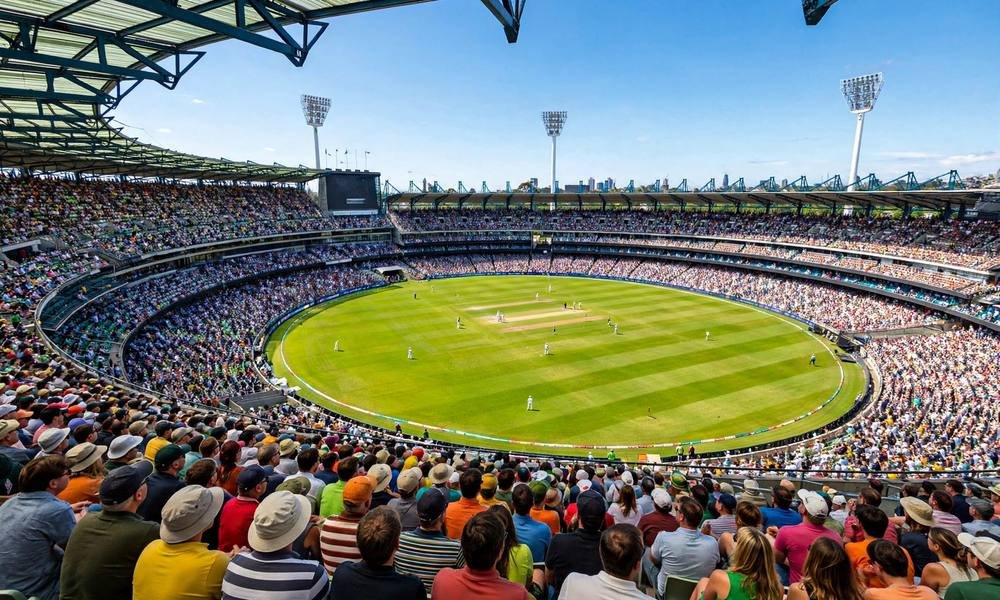
That record will likely never be broken. The ground’s capacity was later cut to 100,024, with about 95,000 seats and some standing room. Even so, the ‘G still fills to the brim. The 2023 Grand Final filled it to capacity, and the 2023-24 Boxing Day Test drew 164,835 people over four days. When the ground is full, the noise is something you feel in your chest. When it is empty on a tour day, the size of the place hits you in a different way. Row upon row of seats climbs to the roof on every side. It is worth seeing both ways if you can.
The MCG Tour: Behind the Scenes
The best way to see the MCG on a day without a match is the guided tour. It runs for about 75 minutes, and it takes you into rooms that normal ticket holders never see. Tours leave from Gate 3, and they run most days between 10am and 3pm. Booking ahead is a smart move, as tours can sell out, and times change around events. Allow about 90 minutes in total once you count check-in and arrival.
Your guide will be someone who knows the ground well. Many guides are MCC members or long-time volunteers, and they tell the stories behind the rooms, not just the facts. The route can change from day to day because the MCG is a working stadium. If a big event is being set up, some rooms may be closed. That is part of the deal, and it is worth knowing before you go.
What You’ll See on the Tour
The tour usually starts with the MCC Long Room, in the members’ pavilion. This is the old centre of the club, full of portraits, wood panelling, and cricket history. The MCC Library sits nearby. It began in 1873 with 13 bound volumes given by the owner of a Melbourne newspaper, and it has grown into one of the finest cricket collections in the world. It holds books on cricket above all, but also on Australian football, the Olympic movement, and other sports.
From there the tour moves through the players’ change rooms, where you can picture the teams getting ready before a big match. You will also see the cricketers’ viewing room and the Shrine to Test Cricket. The Ron Casey Media Centre shows you where the commentators and press sit on match days. The tour takes in the Ponsford Stand, named after the great batsman Bill Ponsford, and the City Terrace, where you get a clear view across the city skyline.
The best moment for most people comes near the end. The guide walks the group along the boundary line, right at the edge of the playing field. Stand there for a second and look up. The empty seats rise in tiers all around you, and it is easy to picture 100,000 people on their feet. It is a quiet moment on a non-event day, and it stays with you.

Tour Times, Prices and Booking
Tours run seven days a week, except on some MCG event days. On event days, tours run only on selected days and hours change, so always check the MCG calendar for your date before you travel. Tours are closed on Christmas Day, Good Friday, and Melbourne Cup Day.
Tickets cost $38 for adults, $26 for concession card holders, and $17 for children aged 5 to 15. A family ticket for two adults and two children costs $91. Children under five go free. A combined ticket that covers the tour and the Australian Sports Museum costs $50 for adults, $32 for concession, $22 for children, and $120 for a family. Prices can change, so check the current prices when you book. Book online before you go, as walk-up spots are not always available. Auslan-interpreted tours are offered on some dates, so ask when you book if you need one.
The Australian Sports Museum
The Australian Sports Museum sits inside the MCG, entered from Gate 3. It is not just a cricket museum. It covers the whole story of Australian sport, from the first Test match to the Olympic Games. Give it 60 to 90 minutes at your own pace. If you buy the combined ticket, visit the museum after your tour, when you already know the ground’s story.
The museum is open daily from 10am to 5pm, except on event days, when hours change. On match days it may open only to ticket holders before the first bounce, so check the calendar for your date. It is closed on Good Friday and Christmas Day.
Galleries Worth Your Time
The cricket gallery is the natural starting point. It covers the first Test in 1877, the Ashes, and the players who made the ground famous. The Australian Cricket Hall of Fame has its own gallery, opened in 1996. The football gallery tells the story of the game that grew up around this ground, from the first matches in the 1850s to the modern AFL.
The Olympic gallery looks at Australia’s Olympic story, with the 1956 Melbourne Games at its centre. You can see the 1956 Olympic Cauldron, a piece of the ground’s own history. The Sport Australia Hall of Fame honours champions from every sport. Its first member was Sir Donald Bradman, and its first woman was Dawn Fraser. Look for the personal items beside the plaques, like Ian Thorpe’s fan mail from the Sydney Olympics, Layne Beachley’s surfboard from her 1998 world title, and the blueprints of Australia II, the yacht that won the America’s Cup in 1983.
Two displays stop most people in their tracks. The Shane Warne hologram brings the great leg-spinner back to life in the museum, and the Sporting Nation gallery looks at how sport fits into everyday Australian life. Behind the scenes, the museum holds a store of more than 70,000 objects that the public rarely sees, from a Melbourne Cup to a 1956 Olympic rowing outfit.

Game On! for Kids
Game On! is the museum’s hands-on gallery, and it is the part kids remember most. Instead of reading labels, children can try sport for themselves. There are activities for surfing, rock climbing, and cycling, plus challenges that test balance and speed. If your kids get restless in the quiet galleries, bring them here and let them burn off some energy. It breaks up the visit well, and it works for grown-ups too. A 75-minute tour plus an hour in the museum is a lot of standing and listening for small children, so plan a break in Game On! or out in Yarra Park.
Watching a Match at the ‘G
Seeing the MCG on a tour is one thing. Seeing it full is another. If you can time your trip for a match, do it. The ground hosts AFL from late March to September, and cricket through the summer. The atmosphere at a big game is the closest thing Melbourne has to a religious experience, and you do not need to understand every rule to enjoy it.
Match tickets and tour tickets are separate products, so a tour ticket will not get you into a game. Buy match tickets only from the official sellers, the AFL, the clubs, or Cricket Australia. Tickets for big games sell fast, and prices change by match and seat. Book early for the Grand Final and the Boxing Day Test.
An AFL Match and the Grand Final
For many visitors, an AFL match is the classic MCG experience. The game is fast, high scoring, and physical, and it is played on the big oval with 18 players a side. The MCG hosts the AFL Grand Final every September, and it is the biggest day on the Australian sporting calendar. The ground fills to its 100,024 capacity, and the whole city stops to watch.
Regular season games run from March to September. Some are easy to attend, with tickets available on the day. Big rivalry matches and finals can sell out, so book ahead. For a first AFL visit, arrive early. Find your section, watch the crowd build, and soak up the pre-game buzz. The noise when the teams run out is worth the early start. If you are new to the game, sit near the middle of a side for the best view of the whole ground.
The Boxing Day Test and Summer Cricket
Cricket takes over the MCG in summer. The Boxing Day Test starts on 26 December each year, and it is one of Australia’s best-known sporting traditions. The match runs for up to five days, and crowds build through the week. The ground also hosts one-day internationals and Big Bash League games, which are shorter, louder, and great for families.
Test cricket is a slow game with long days. Bring sunscreen, a hat, and a refillable water bottle. Melbourne’s summer weather can change fast, so a hot morning can turn cool and wet by the afternoon. Pack a light rain jacket just in case. Food and drink are sold all around the concourse, and you can move around the ground between sessions. If you want the full Boxing Day experience, book early. It draws visitors from all over the world.
Night Matches, Concerts and Big Events
Many games at the MCG are played at night, under lights. A night match makes a great evening out, and the ground looks its best when the lights come on. In the early rounds of the 2026 season, the MCG hosted several Thursday and Friday night matches. After a night game, Richmond fills up. The pubs on Swan Street and Bridge Road show the football on big screens, and the streets stay busy late.
The ground also hosts concerts, international soccer, and rugby. The MCG was built for cricket and football, but it has held Olympic events, Commonwealth Games ceremonies, and some of the biggest concerts to tour Australia. Seating and entry change with each event, so always check the seating plan and gate details for your event rather than relying on a general stadium map.
How Much Time Do You Need?
How long you need depends on what you want to do. For an MCG Tour only, allow about 90 minutes, including arrival and check-in. The tour itself runs for 75 minutes. For the Australian Sports Museum on its own, allow 60 to 90 minutes. For the combined tour and museum visit, allow 2.5 to 3 hours.
On a match day, allow much more. A full day at the cricket can run six to seven hours, and an AFL match takes about three hours plus travel and entry time. Arrive early on event days. You will need time to get through the gates, find your seats, and explore the concourse before the start. If you combine the MCG with nearby attractions like Federation Square or the Royal Botanic Gardens, you can easily fill half a day in the sporting precinct.
Best Time to Visit the MCG
The best time to visit depends on what you want from the day. If you want the tour and the museum, pick a non-event day. Tours run most days, the rooms are open, and the ground is quiet enough to take it all in. Midweek mornings are usually the calmest. Weekends can be busier, and school holidays bring more families.
If you want the roar of a crowd, come for a match. The AFL season runs from late March to September, and the Grand Final in September is the biggest game of the year. Cricket season runs from November to February, with the Boxing Day Test as the highlight. The Big Bash League games in December and January are fun, fast, and family friendly. Winter matches can be cold and wet, so dress warmly. Summer days can be very hot, so bring sun protection and water.
Autumn and spring are good months for a tour. The weather is mild, and the ground is less busy between seasons. Whatever time you choose, check the MCG event calendar before you go. A match-free day does not always mean every room is open, as event set-up can close parts of the ground.
Getting to the MCG
The MCG sits in Yarra Park, about 1.5 kilometres south-east of the city centre. Public transport is the easiest way to get there, especially on event days. Driving is possible, but parking is limited and roads close around big events.
By Train and Tram
Jolimont Station is the closest stop. It sits north of the stadium, served by the Hurstbridge and Mernda lines. From the station it is about a five-minute walk through Yarra Park to the ground. Richmond Station is also close, and it serves the southern gates and several eastern and bayside lines. Choose your station around the gate on your ticket, as a walk to the wrong side of the ground can add a lot of time.
Trams are a good option too. Routes 48 and 75 run along Wellington Parade and stop at Jolimont Station and the MCG. Route 70 runs to the Melbourne Park side, with Stop 7B handy for gates 1 to 3 and Stop 7C for gates 4 to 7. Check for service changes before you travel, as tram stops can move around events.
Walking from the City
Walking from the city centre is easy and pleasant. From Federation Square or Flinders Street Station, the walk takes about 15 to 20 minutes. Cross the Yarra River on the William Barak Bridge, then walk through Birrarung Marr and into Yarra Park. The path is well signed on event days, and thousands of fans walk the same way, so you will not get lost. It is one of the nicest walks in the city, with the ground’s light towers rising over the trees as you get close.
Parking and Driving
There is no parking at the MCG for tour and museum visitors, so do not plan to drive to the gate. On event days, parking in Yarra Park is limited and depends on the event and the weather. When it runs, the fee is $20 per vehicle, paid by card. Some events only offer pre-booked parking for Australian Disability Parking permit holders. An ordinary stadium ticket does not reserve a parking spot.
If you must drive, the nearest public car park is the Eastern Plaza car park on Olympic Boulevard, about an 11-minute walk from the ground. There is also limited street parking on Wellington Parade, Jolimont Street, and Jolimont Terrace. Taxis and rideshares drop off at the bus turning circle on Jolimont Terrace, about five minutes from Gate 3. Barassi Way, once called Brunton Avenue, can close around events. Public transport is almost always the simpler choice.
A Free Walk in Yarra Park
Do not rush straight from the station to the gate. Yarra Park is worth a slow walk, and it costs nothing. Two lines of statues stand in the park. The Parade of Champions honours greats like Don Bradman, Bill Ponsford, Dennis Lillee, Ron Barassi, and Betty Cuthbert. The Avenue of Legends includes Shane Warne and Jim Stynes, among others. The statues make a good photo stop, and they tell the story of Australian sport in bronze.
Look out for the scarred river red gum near the ground. Its trunk carries a scar where bark was cut to make a canoe, and it was listed as a heritage tree in 1982. The plaque records the bark’s use for canoe-making by Aboriginal people. The national heritage assessment counts three such scarred trees in the park. It is a quiet reminder that people gathered on this land long before the first cricket match.
The walk from Gate 3 through the park to the city is lovely at sunset, when the light towers glow and the crowds thin out. If you have time after your tour, keep walking to the Royal Botanic Gardens or along the Yarra River. Both are close, and both are free.
Where to Stay Near the MCG
The closest hotel to the ground is Mantra on Jolimont, about 350 metres from the MCG. It is the easy choice if you want to walk to a match or a morning tour. The city centre is only a 15 to 20-minute walk away, so any CBD hotel works well too. Staying in the city puts you close to the laneways, Queen Victoria Market, and the best restaurants in Melbourne.
Richmond, just south of the ground, is another good base. It has pubs, cafes, and restaurants on Swan Street and Bridge Road, and it comes alive on match nights. East Melbourne, on the other side of the park, is quieter, with leafy streets and easy access to Fitzroy Gardens. For a first visit, the CBD is the simplest choice. You can walk to the ground, and you are close to everything else in the city.
A Half-Day Plan for the MCG and the Sports Precinct
Here is a simple plan that works well for a first visit. Start at Federation Square in the morning. Walk across the William Barak Bridge and through Birrarung Marr to Yarra Park. Take your time past the statues on the way to Gate 3.
Join the 10am MCG Tour. You will be finished by about 11:30am. Head straight into the Australian Sports Museum for an hour, with a stop in Game On! if you have kids with you. By early afternoon you will have seen the ground properly. Walk back through the park, then cross to the Melbourne Park side to see Rod Laver Arena and AAMI Park from outside. Finish the day with a late lunch in Richmond, on Swan Street or Bridge Road, where the pubs and cafes fill up after a match or a tour.
If you have a full day, add the Royal Botanic Gardens in the afternoon, or cross the river to the Melbourne Museum in Carlton. Both are a short tram ride away, and both pair well with a morning at the ‘G.
Visiting with Kids
The MCG works well for families, on event days and on tour days. The Australian Sports Museum is the most family-friendly part of the visit. Game On! gives kids something to do with their hands, and the galleries have enough to hold older children. Children under five go free on standard tours and museum visits. Kids aged 5 to 15 pay child prices.
The tour is 75 minutes of walking and listening, which can be a lot for young children. Plan a break in Game On! or out in Yarra Park after the tour. The museum has two Parents’ Rooms with feeding cubicles and change tables, one in the museum and one near Gate 3. There is also a Changing Places facility inside Gate 3. The MCG has not published pushchair rules for the tour, so ask when you book. Lifts and ramps are available, and the guide can point out the ramp to the arena.
For matches, think about crowd size, noise, and late finishes. A day game is easier with small children than a night match. Big crowds can be overwhelming, and some games finish late. Family seating areas are available at some events. Bring ear protection for very young children if you are going to a loud game.
Accessibility at the MCG
The MCG offers broad accessibility support for visitors. Accessible seating areas are available at events, with space for companions nearby. Accessible bathrooms, lifts, and ramps are spread through the stadium. Hearing augmentation systems help visitors with hearing loss follow announcements and commentary. Assistance animals are welcome, though you should check the event rules first.
The free G-Train mobility shuttle runs on event days for visitors with mobility challenges. It picks up from Richmond Station, Jolimont Station, and accessible parking areas when they are in use. The MCG also takes part in the Hidden Disabilities Sunflower program, so staff can spot visitors who may need extra help. Accessible event seating should be booked in advance through the proper ticketing process. If you need help on the day, ask staff at the gate or at an information desk.
Food, Drink and the MCG Superstore
On event days, food and drink outlets run right through the stadium. You will find hot food, snacks, drinks, bars, and cafes in the concourse, with options that change by stand and event. Named spots include the Paddock Cafe, the Bullring Bar, and food courts in the Great Southern Stand and the Hill Stand. Free drinking fountains are available, so bring a refillable water bottle.
On non-event days, food inside the ground is limited. The museum and tour pages list no cafe hours for quiet days, so eat before you come or ask when you book. Richmond and East Melbourne have plenty of cafes and restaurants a short walk away, and the CBD is 15 minutes on foot. After a tour, a late lunch on Swan Street or Bridge Road is a good way to end the visit.
The MCG Superstore sits at Gate 3, behind Bay M51. It sells official team gear, clothing, and souvenirs from the sports played at the ground. Smaller merchandise outlets open around the stadium on event days. If you want a souvenir, the Superstore is the best place to look, and it is easy to reach before or after a tour.
Good to Know Before You Go
A few practical points will make your visit smoother. First, check the MCG event calendar before you travel. Tour times, museum hours, and room access all change around events, and a match-free day does not guarantee that every room is open. Second, book your tour online in advance. Tours sell out, and walk-up spots are not always available.
Third, travel light. The MCG has bag rules, and large bags may not be allowed in. Small bags are fine, but check the current bag policy for your event before you go. There is no cloakroom or baggage storage for visitors, so do not bring anything you cannot carry. Fourth, wear comfortable shoes. The tour involves a lot of walking and some stairs, and the ground is big.
Melbourne weather is famous for changing fast. A sunny morning can turn to rain by lunch, and a hot day can cool quickly. Bring a hat, sunscreen, and a light rain jacket, whatever the forecast says. Photos are allowed on the tour and in the museum, so bring your camera. The view from the boundary and the City Terrace is worth a photo. Finally, remember that match tickets and tour tickets are separate. A tour ticket will not get you into a game, and a match ticket does not include a tour.
FAQs About Visiting the MCG
Can I visit the MCG without going to a match?
Yes. Book an MCG Tour, Australian Sports Museum entry, or a combined ticket for a suitable date. Tours and museum hours can change around events, so check the calendar for your date before you go.
How long should I allow for the tour and museum?
The guided tour takes about 75 minutes. Allow about 90 minutes in total with check-in. The museum takes 60 to 90 minutes. For the combined visit, allow 2.5 to 3 hours.
Is the museum included in the tour ticket?
No. A tour-only ticket does not include the Australian Sports Museum. Choose the combined ticket if you want both. A combined adult ticket costs $50, compared with $38 for either attraction on its own.
Where do tours and museum visits start?
Use Gate 3 for the Australian Sports Museum and MCG Tours. This is different from match entry, when your event ticket tells you which gate and seating area to use.
Can young children visit?
Yes. Children under five go free on standard tours and museum visits, and kids aged 5 to 15 pay child prices. The museum’s Game On! gallery is made for children. For matches, think about crowd noise and late finishes before you bring small children.
Which station is best for the MCG?
Jolimont is best for the northern side and Gate 3. Richmond Station suits the southern gates. Your gate and train line decide the better choice. Walking from Flinders Street through Birrarung Marr is another good option.
Is parking always available in Yarra Park?
No. The car park opens by event, and it depends on capacity and ground conditions. Some events offer only pre-booked parking for permit holders. Public transport is usually the safer choice.
Can I take photos inside the MCG?
Yes. Photography is allowed on the tour and in the museum. The boundary walk and the City Terrace are the best photo spots. Some museum displays may ask you not to use flash, so follow the signs.
Final Thoughts on Visiting the MCG
The Melbourne Cricket Ground is more than a stadium. It is where Test cricket began, where the Olympics came to Melbourne, and where 121,696 people once watched a Grand Final that is still talked about today. It is also a place you can walk into on a quiet weekday, stand on the edge of the turf, and feel the size of it with no crowd at all. That mix of history and scale is what makes the ‘G special.
If you only do one thing here, take the tour. It is the only way to see the Long Room, the library, the change rooms, and the boundary up close, and the guides tell the stories that make the rooms matter. Add the museum if you have time, and walk through Yarra Park to see the statues and the scarred tree. If you can, come back for a match. The ground is at its best when it is full, and the noise of 100,000 people is something you will not forget. Plan your trip with our things to do in Melbourne guide, and give the ‘G the half day it deserves.
Keep exploring:
- Things to Do in Melbourne: Complete Guide
- Federation Square Melbourne: Complete Guide
- Royal Botanic Gardens Melbourne: Visitor Guide
- Melbourne Museum: Complete Visitor Guide
- Queen Victoria Market: Complete Guide
- Melbourne Laneways: Complete Guide
- Melbourne Zoo: Complete Visitor Guide
- Best Restaurants in Melbourne