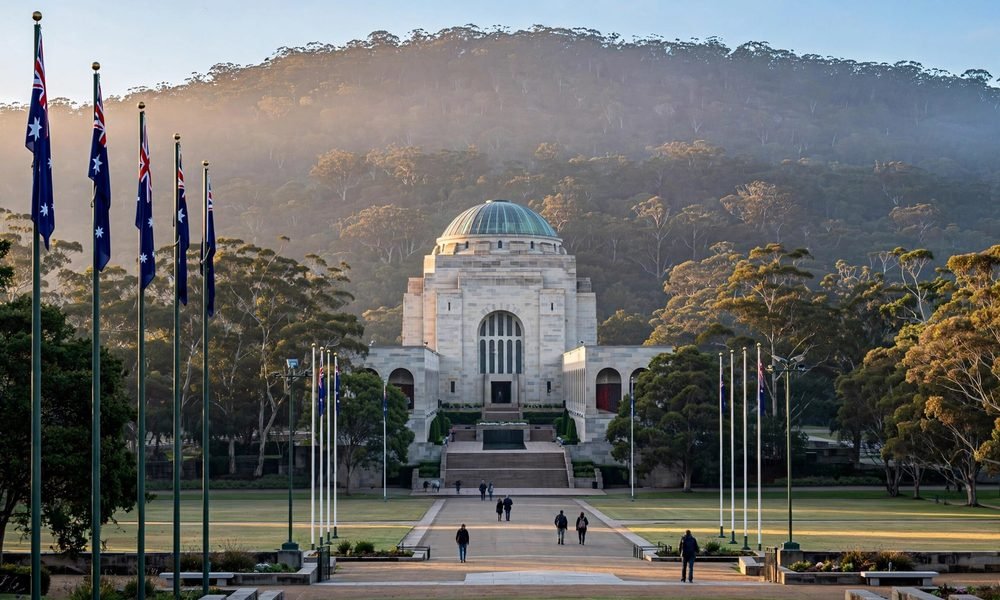

The Australian War Memorial in Canberra is the one stop every first-time visitor should make. It sits at the base of Mount Ainslie at the northern end of Anzac Parade, part shrine, part world-class museum, and part research archive. Entry is free, and even if military history is not your thing, the personal stories inside make it hard to walk through unmoved.
Give it at least half a day. The galleries trace Australia’s wartime story from Gallipoli to Afghanistan, and every afternoon the day closes with the Last Post Ceremony in the Commemorative Courtyard. This guide covers what to see, how to time your visit, where to stay nearby, and the practical must-knows, all checked against the 2026 reality of the Memorial’s big redevelopment. If you are planning a broader Canberra trip, the team at Australia City Guide has the rest of the capital covered too.
The Commemorative Area and Hall of Memory
Start here, or at least do not skip it. The Commemorative Area is the solemn centre of the Memorial, and it sets the tone for everything else.
Hall of Memory and the Tomb of the Unknown Australian Soldier

The Hall of Memory sits beneath the Memorial’s domed roof. Step inside and you will find walls of rich mosaics, stained glass windows, and in the centre, the Tomb of the Unknown Australian Soldier. He is an unknown infantryman killed in France during the First World War, brought home in 1993 to represent every Australian who died without a known grave.
People speak quietly here without being told. Allow yourself a few minutes of stillness. It is the most visited single spot in the building, and it deserves your time.
The Roll of Honour and Pool of Reflection
From the Hall of Memory you step into the cloistered courtyard where bronze panels list the names of more than 102,000 Australians who lost their lives in war. Reading one name at a time, you start to grasp what the numbers actually mean: interrupted families, unfinished studies, lives cut short.
Many visitors look up a relative’s name here. The panels are organised by conflict, and small paper poppies tucked beside names show where other families have been. The Pool of Reflection at the courtyard’s edge gives you a quiet place to sit with it all for a moment.
The Galleries: Australia’s Wartime Story
The museum galleries hold the nation’s collection of wartime objects, from Gallipoli letters home to a full Lancaster bomber. Since the redevelopment began in 2020, the gallery route keeps changing, so treat any old floor plan with suspicion and check the live exhibitions list before your visit.
First and Second World War Galleries
These are the backbone of the museum. The First World War gallery is immersive rather than dry: life-size dioramas, personal letters, and recovered objects like a bullet-marked trench sign from Gallipoli. It follows Australians from enlistment through the Western Front, and it is especially strong on the human side of soldiering, the boredom and mateship as well as the battles.
The Second World War gallery shifts the mood. Sound and light displays recreate the intensity of the Bomber Command raids, and the Kokoda Track section covers the brutal jungle campaign where Australian troops held off the Japanese advance on Port Moresby. Expect to spend an hour in each if you read as you go.
Anzac Hall, Aircraft Hall and G for George

Anzac Hall is the big-objects hall, the one kids remember. The 2026 reopening brought back the stars of the collection, including “G for George”, the Lancaster bomber that flew 89 missions over Germany and occupied Europe between 1942 and 1944. It now anchors a new gallery on Australians in RAF Bomber Command.
The lower level of the new Anzac Hall covers more recent service: Iraq, Afghanistan and peacekeeping operations. The connecting Anzac Atrium shows objects rarely seen before, including a German V-2 rocket trailer from the Second World War and a Chinook helicopter that supported the Australian Army in Afghanistan.
Hall of Valour
Do not walk past the Hall of Valour. It holds the largest collection of Victoria Crosses and George Crosses in the country, each with the story of the act behind it. Captain Alfred Shout’s VC from Lone Pine at Gallipoli, Nancy Wake’s George Cross for her resistance work in occupied France, Mark Donaldson’s VC from Afghanistan, each one reads like a novel compressed into a paragraph.
War Art, Temporary Exhibitions and the Sculpture Garden
The Memorial collects Australian war art, and it is worth more of your time than most people give it. Official war artists from Sidney Nolan onward painted fear, exhaustion and aftermath in ways no photograph captures. Check what is on while you are visiting, as the temporary exhibitions rotate and the Memorial’s exhibition on art from the national collection runs through the redevelopment years.
Outside, the Sculpture Garden is a calmer circuit of memorials and artworks among the trees. It is a good breather between the heavy indoor galleries and the ceremony. Admission to the permanent collection is free, though some special exhibitions may be ticketed, so check the listing for your dates.
The Daily Last Post Ceremony

At around 4.30pm each day, the Memorial farewells its visitors with the Last Post Ceremony in the Commemorative Courtyard. It is simple and dignified: an anthem, a lament, sometimes a wreath laying, then the story of one person chosen from the Roll of Honour, the Ode, and the sounding of the Last Post.
One name, one story. That format is what makes it land. A teenager from the Western Front, a nurse, a peacekeeper, the ceremony refuses to let anyone become just a statistic. It is genuinely moving even for people who arrived sceptical.
Arrive early for a respectful viewing spot, as it draws a crowd. Phones go on silent, hats come off, and you stand still through the Ode and the minute’s silence. Photography is fine but discreet, and never with flash. The ceremony goes ahead in most weather, though staff will adjust arrangements in severe conditions. If you cannot be there in person, it is streamed online each day.
One planning note with real consequences: the galleries begin closing progressively from 4pm ahead of the ceremony. See the galleries first in the afternoon, then take your place in the courtyard. Do it the other way around and you will be locked out of half the museum.
How Long You Need and the Best Time to Visit
A half day is the sensible minimum for a first visit: galleries plus the Commemorative Area plus the Last Post. Rushing it in under three hours is possible, but you will leave knowing you skimmed it.
Sample plans for different visit lengths
Two to four hours: Commemorative Courtyard, Hall of Memory, First World War gallery, quick stop at Poppy’s Café, then the Last Post Ceremony.
Half day: add the Second World War gallery, Anzac Hall and the Hall of Valour. Walk a section of Anzac Parade between the museum and the ceremony if your feet allow.
Full day: see everything at an unhurried pace, fit in a temporary exhibition, spend real time in the war art, and drive up to the Mount Ainslie lookout for sunset afterwards.
Best time of day and year
Mornings are quieter in the galleries, and school holidays are noticeably busier. If the Last Post matters to you, plan the whole day backwards from 4.30pm. Spring and autumn give you the best Canberra weather for the outdoor parts: the Sculpture Garden, the Anzac Parade walk and the Mount Ainslie view. Summer afternoons are best spent inside the air-conditioned galleries, and winter mornings are crisp but glorious if you rug up.
Where to Stay Near the Memorial
You do not need to stay far away. The Memorial is in Campbell, a quiet suburb just north of the lake, and several good bases are within a few minutes’ drive.
Campbell: the closest option, with apartments and a hotel right near the Memorial. Ideal if you want to be first through the doors.
Reid: a leafy heritage suburb between the Memorial and the city centre, good for characterful B&Bs and short stays.
Braddon: Canberra’s food and coffee strip, about five minutes by car. Best pick if you want dinner options within walking distance after a full day.
Civic (city centre): the widest choice of hotels and the easiest public transport access to the Memorial.
If you are spending several days in the capital, the Memorial anchors the north side of the lake while Parliament House anchors the south, and staying central keeps both within easy reach.
Getting There and Parking
The address is Treloar Crescent, Campbell ACT 2612, at the northern end of Anzac Parade. Driving is the easiest option for most visitors. Visitor parking is in the P1 underground car park beneath Poppy’s Café, which includes accessible bays, though arrangements can shift during the redevelopment works, so check the official getting-here page on the day.
By public transport, bus route 54 runs from the Canberra City Interchange toward Campbell, stopping on Fairbairn Avenue and Limestone Avenue, both a short walk from the entrance. The trip takes about 12 minutes. Rideshares and taxis have drop-off points near the entrance, and there is coach parking for tour groups.
Tours, Tickets and Must-Knows Before You Go
General entry is free and no tickets are required, which still surprises people given the scale of the place. Donations are welcome and go toward the Memorial’s work.
Free guided tours
The volunteer-led guided tours are one of the best things on offer and they cost nothing. Options run from 30 to 90 minutes, variously covering Memorial highlights or specific galleries. The guides are passionate and full of the small details that never make it onto labels. Spaces can be limited, so ask about the day’s tours at the arrival desk rather than assuming you can join at any moment.
Eating and facilities
Poppy’s Café sits within the grounds and serves coffee and meals through the day. It is the obvious lunch or morning-tea stop mid-visit. Beyond the café, Campbell has a handful of local spots, and Braddon or Civic are minutes away for a proper dinner after the Last Post. The Memorial also has a gift shop with books, prints and poppy merchandise that actually relate to the collection.
Practical details
Wear comfortable shoes; the galleries cover two levels and you will walk further than you expect. Photography is welcome in most areas but flash is off-limits in the galleries. Bags are screened at the entrance, so arrive a few minutes early if you are cutting it fine for a tour. The building is wheelchair accessible with lifts, and wheelchairs are available for free hire. Because the redevelopment is progressively reopening galleries through 2028, the single most useful thing you can do before leaving home is check the Memorial’s live visit page for your date.
Visiting with Kids
Kids do well here if you plan for their pace. Anzac Hall is the winner for younger visitors: big aircraft, vehicles and hands-on displays beat wall text every time. The Discovery Zone is designed for children to explore history through activities rather than reading.
Do not try to do the whole museum with small children. Pick two or three galleries, break at the café, and let them run some energy off in the Sculpture Garden. Before the Last Post, have an age-appropriate chat about what the ceremony is; the Memorial itself carries a content advisory because the stories can be distressing, and forewarned kids cope far better. School groups visit in large numbers during term time, so holidays can actually be calmer for families.
Visiting on Anzac Day
25 April is a different beast from a normal visit. The Memorial hosts the national Dawn Service, the national ceremony and the veterans’ march, drawing tens of thousands of people. It is an extraordinary experience and an extremely early start.
If you go, arrive hours before dawn, dress for a cold Canberra morning, and accept that you will see very little of the galleries themselves that day. Many first-timers prefer to visit the Memorial on an ordinary day for the galleries and ceremony, then attend the Dawn Service as a separate event. Remembrance Day on 11 November is smaller but also busy at the 11am minute of silence.
Researching a Family Member
Many visits start with a name. The Charles Bean Research Centre holds the Memorial’s archives: service records, diaries, letters and photographs. If you are tracing a relative, look up their record on the Memorial’s collection search before you visit, and note the conflict and unit so you can find them on the Roll of Honour panels.
If a particular name matters to your trip, check the upcoming Last Post Ceremony schedule. The names are scheduled in advance, and seeing your relative’s story read aloud is something families travel across the country for. Contact the Memorial before making travel plans if the date matters, as schedules can change.
FAQs About Visiting the Australian War Memorial
Do I need tickets or bookings?
No. General entry is free and tickets are not required. Some special exhibitions may be ticketed, and guided tours have limited spaces, so check the official pages for your dates.
What time is the Last Post Ceremony?
It starts at around 4.30pm daily in the Commemorative Courtyard. Arrive early for a good spot, and remember the galleries start closing from 4pm, so visit them first.
Is the Memorial open during the redevelopment?
Yes. The redevelopment program began in 2020 and runs to 2028, but the Memorial stays open throughout. The new Main Entrance opened in February 2025, the Aircraft Hall reopened in 2026, and new Anzac Hall galleries are opening progressively. Some galleries may be temporarily closed on your date, so check the live exhibitions list beforehand.
How much time should I allow?
Three to four hours is a practical minimum, and a half day lets you see the galleries properly and stay for the Last Post. A full day suits anyone who reads every label or wants the temporary exhibitions too.
Can I take photos?
Yes, in most areas. Flash photography is prohibited in the galleries, and be discreet during the Last Post Ceremony.
Is there somewhere to eat?
Poppy’s Café is inside the grounds and open daily. For more choice, Braddon and Civic are a few minutes away by car.
What should I wear and bring?
Comfortable walking shoes, layers for the season, and sun protection for the outdoor areas. Large bags are screened at the entrance.
Final Thoughts on Visiting the Australian War Memorial
The Memorial works on two levels at once. It is a first-rate museum full of remarkable objects, and it is a place of national grieving that asks something of you. Give it the half day it deserves, time your visit around the Last Post, and do not skip the Hall of Memory or the Hall of Valour. The Australian Capital Territory has plenty of fine attractions, but this is the one that stays with you.
Pair it with a walk down Anzac Parade and a sunset from the Mount Ainslie lookout for the classic Canberra day, and round it out with a tour of Parliament House on the other side of the lake. For more ideas on filling your days in the capital, see our round-up of free things to do in Canberra.