Some museums feel like a chore. The National Museum of Australia is not one of them. Sitting on the Acton Peninsula beside Lake Burley Griffin, it tells the story of Australia through more than 210,000 objects, from Aboriginal bark paintings that are thousands of years old to the heart of Phar Lap. It is also one of the biggest cultural draws in Australian Capital Territory, and the best part is that general entry is completely free.
If you are planning a Canberra trip, this visitor guide from Australia City Guide walks you through everything: the galleries, the standout objects, the building itself, how to get there, where to eat, and how to plan your time so you see the best of it in one visit.
The Galleries: What You’ll See Inside
The museum has three permanent galleries, plus temporary galleries that host changing exhibitions. You can wander them on your own or join one of the daily guided tours (more on those below).
First Australians Gallery
This is the gallery most visitors talk about afterwards. Spread across upper and lower levels, it covers more than 50,000 years of Aboriginal and Torres Strait Islander heritage. You will see bark paintings, stone tools, and objects that tell stories of culture, spirituality, and survival. The collection here is one of the most respected of its kind anywhere in the world, so give it proper time.
Landmarks Gallery
Landmarks picks up the story from 1788 and carries it through to modern Australia. It covers the big chapters: British settlement, farming, mining, industry, democracy, and Federation. The objects are tied to real people and real turning points, which makes the history feel personal instead of textbook-like.
Great Southern Land
This gallery explores Australia’s natural world and the way people relate to the land. Keep an eye out for the giant bunya pine tree trunk display, which gives you a sense of scale that photos just can’t capture. Kids tend to love this gallery because there’s plenty to look at up close.
On top of the permanent galleries, the museum runs a rotating program of special exhibitions throughout the year, featuring Australian and international stories. Some are free and some are ticketed, so check what’s on before your visit.
Collection Highlights Worth Seeking Out
With more than 210,000 objects in the National Historical Collection, it helps to know the famous pieces before you arrive. Here are the ones to put on your list:
- Phar Lap’s heart: the heart of Australia’s most famous racehorse, kept in a climate-controlled display. It draws a crowd, so expect company.
- The 1948 Holden prototype: the car that started Australia’s love affair with the Holden. A must for car fans.
- The Holey Dollar: the first coin ever minted in Australia. Small object, big story.
- Captain Cook’s navigational instruments: the actual tools used on the voyages that mapped Australia’s east coast.
- Cadel Evans’ cycling gear: memorabilia from the 2011 Tour de France winner, a favourite with sports fans.
- Sydney 2000 Olympics collection: objects from the Games that put Sydney on the world stage.
- Aboriginal bark paintings: the museum holds the world’s largest collection of these, and seeing them in person is genuinely moving.
- The World Trade Center flag: an Australian flag recovered from the ruins of the World Trade Center after the 2001 attacks, a moving reminder of a global event.
The Building Is Half the Experience
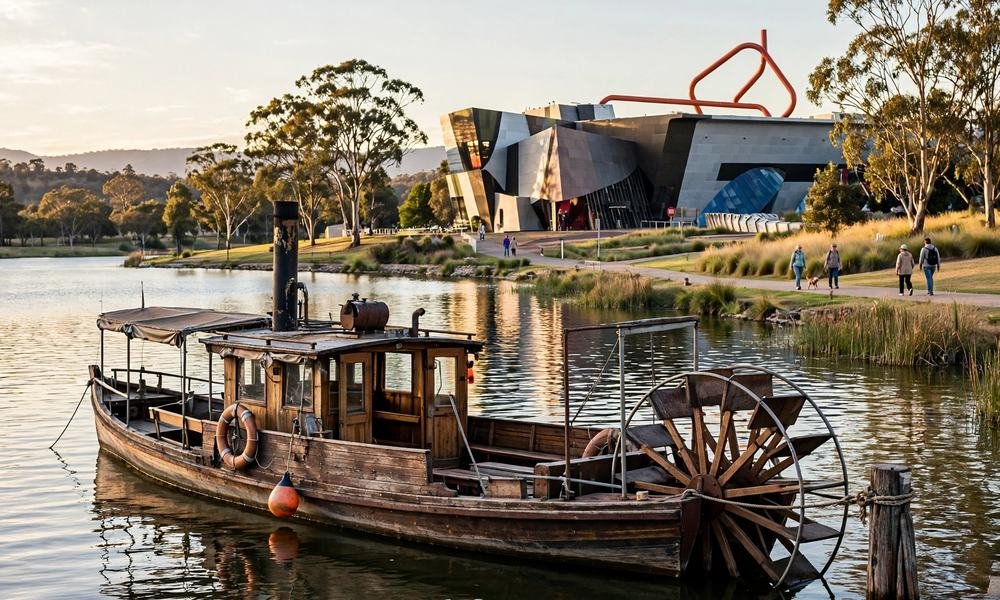
Plans for a national museum began with an Act of Parliament in 1980, but the doors didn’t open until 11 March 2001, as a project marking 100 years since Federation. The wait was worth it. The building, designed by Ashton Raggatt McDougall under lead architect Howard Raggatt, is a bold piece of postmodern architecture built around the idea of knotted ropes, a symbol of the stories that connect all Australians.
Look closely and you will notice the aluminium panels on the outside are etched with braille text. Inside, the Uluru Axis walkway is deliberately aligned toward Uluru, which is a nice touch once you know it’s there.
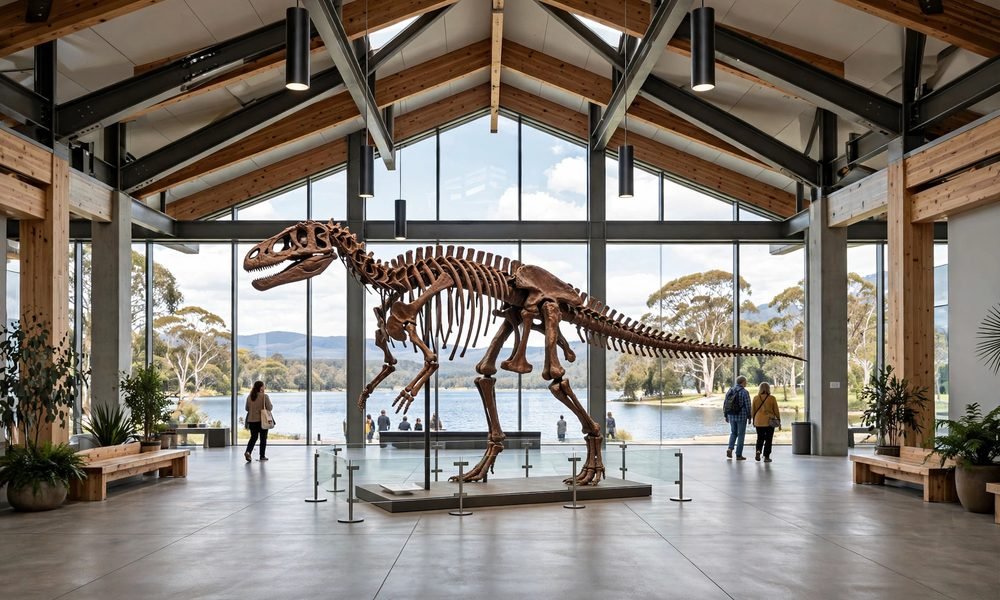
The Gandel Atrium is the grand entrance hall, with floor-to-ceiling windows looking straight out over the lake. It displays collection favourites that have been greeting visitors since 2001: the Muttaburrasaurus skeleton, a Pink Propert Trailaway caravan, and a 1950s Holden. The information desk, cafe, and gift shop are all here too, so this is where every visit begins.
Garden of Australian Dreams and the Lakeside Grounds
Don’t rush back to your car when you finish the galleries. The Garden of Australian Dreams is an outdoor courtyard of native plants, winding paths, water features, and sculptures that reflect Australian symbols and stories. It’s a calm spot to sit for ten minutes and let everything you just saw sink in.

Down by the water you’ll spot the Paddle Steamer Enterprise, moored on Lake Burley Griffin. Built in the Victorian town of Echuca in 1878 from river red gum, she worked as a cargo boat, fishing vessel, floating store, houseboat, and showboat. She is one of the oldest working paddle steamers in the world and the largest functioning object in the museum’s collection, so walk down for a closer look and a photo.
A Great Day Out for Families
If you’re visiting with kids, head for the Tim and Gina Fairfax Discovery Centre on the lower ground floor, just past the Garden of Australian Dreams. It’s a hands-on play space built for young explorers. Note that it is ticketed separately from general entry, so check prices on the museum’s website.
The museum makes family visits easy in other ways too. There are parents rooms on the ground floor and at the Discovery Centre, with change tables and a microwave, and breastfeeding is welcome anywhere in the building. Older kids might enjoy the museum’s free app, which offers a self-guided audio tour they can follow at their own pace. Most families spend a relaxed half day here without anyone getting bored.
How Much Time Do You Need?
Set aside two to three hours for the permanent galleries at a comfortable pace. If you want to see a special exhibition, have lunch at the cafe, and wander the garden, plan for half a day. Families with kids in the Discovery Centre often stay the longest.
Best Time to Visit
The museum is open every day from 9am to 5pm and closes only on Christmas Day. Weekday mornings are the quietest, while weekends and school holidays bring bigger crowds. If you’re keen on a special exhibition, check the museum’s calendar before you go, since the program changes through the year.
Getting to the Museum
By bus
Bus route 53 runs to the museum seven days a week. Get off at the Lennox Crossing stop, about 200 metres from the entrance. Check the timetable on the Transport Canberra website before you head out.
Driving and parking
Driving is straightforward: the museum sits on Lawson Crescent on the Acton Peninsula, reached via Parkes Way and Barry Drive. Parking costs $4.40 per hour or $18 per day between 8.30am and 5pm on weekdays. Parking is free on weekends, public holidays, for motorbikes, and for mobility permit holders. Parking is monitored by the National Capital Authority, so read the signs for short-stay and long-stay zones.
Walking and cycling
If you’re staying in the city, the shared path network makes for a lovely walk or ride. The Lake Burley Griffin circuit passes right by the museum and connects with paths across Canberra. Cycling is one of the nicest ways to arrive on a fine day.
Taxi and rideshare
Taxis and rideshares pick up and drop off at the taxi zone under the big orange loop near the main entrance, so you can’t miss it.
Entry Fees and Tickets
Entry to the National Museum of Australia is free, which makes it one of the best value days out in Canberra. You only pay for special exhibitions, some guided tours, and the Discovery Centre. Book tickets for paid experiences on the museum’s website before you visit, especially on weekends. Concession cards are accepted for most paid experiences, and if you’re a regular visitor, the Friends membership brings discounts, a lakeside lounge, and unlimited entry to paid exhibitions.
Where to Stay Near the Museum
Staying close to the museum means you can walk or ride there and still be central for the rest of Canberra’s big attractions. Three solid options nearby:
- Peppers Gallery Hotel Canberra: about 15 minutes’ walk from the museum. The building has its own story: it was originally designed for VIP guests attending the opening of Australia’s first Parliament House.
- BreakFree Capital Tower: around 20 minutes on foot, with apartment-style rooms plus a pool and gym. A good pick for families who want extra space.
- Novotel Canberra: on Northbourne Avenue, a central base with a restaurant, indoor heated pool, spa, sauna, and gym.
A Civic or Acton base also keeps you handy for Parliament House and the Australian War Memorial, so you can stack your museum days together.
A Simple Half-Day Plan
Not sure how to order your visit? This easy plan covers the best of it without rushing:
- 9.30am: Arrive and walk through the Gandel Atrium. Say hello to the Muttaburrasaurus.
- 10.00am: Start with the First Australians Gallery while it’s quiet.
- 11.00am: Move through the Landmarks Gallery.
- 12.00pm: Explore Great Southern Land and any special exhibition.
- 1.00pm: Lunch at the Museum Cafe with lake views.
- 2.00pm: Wander the Garden of Australian Dreams and walk down to the Paddle Steamer Enterprise.
- 2.45pm: Finish in the Museum Shop for souvenirs.
Guided Tours Worth Booking
If you’d rather be shown around than read every label, the museum’s daily tours are a good call. The building and architecture tour runs at 10am, the museum highlights tour at 1pm, and the First Australians tour at 3pm. These are paid experiences and bookings are essential, so reserve your spot on the museum’s website. Prefer to go solo? The free museum app offers a self-guided audio tour, and it’s worth grabbing a paper map from the information desk, since the layout can be a little confusing at first.
The Museum Cafe and Museum Shop
The Museum Cafe is open daily from 9am to 4.30pm, serving breakfast, lunch, coffee, and drinks with big windows looking over the lake. The menu covers vegetarian, vegan, gluten-free, and dairy-free options. Bookings run on a 1.5-hour seating, so book ahead if you’re visiting at lunchtime on a weekend. You can also bring your own food and eat in the Gandel Atrium or outside, just not inside the galleries.
The Museum Shop is open 9am to 5pm daily and stocks Australian-made gifts, homewares, jewellery, books, toys, and First Nations products from artists and art centres. It won Silver at the 2023 Australian Tourism Awards for tourism retail, so the range is genuinely good. Every purchase supports the museum’s work.
Bags, Photos and Other Visitor Rules
A few practical rules to know before you arrive. Bags bigger than an A4 sheet, plus umbrellas, must be cloaked at the information desk, and the service is free. Food and drink are not allowed inside the galleries. Photography for personal use is allowed in the galleries except where signs ask you not to take photos. Free wi-fi (look for NMA-PUBLIC) is available throughout the building.
Accessibility at the Museum
The museum is well set up for visitors with accessibility needs. Lifts reach all three levels, and there are seven accessible parking spaces plus four pram spaces about 40 metres from the main entrance. Wheelchairs and motorised scooters are available free of charge if you book 24 hours ahead. Four portable hearing loops can be borrowed from the information desk. Quiet hours run on the first Tuesday of each month for visitors who prefer reduced noise and lighting. Trained assistance animals are welcome, there’s a Changing Places toilet with an adult change table on the lower ground floor, and a multi-faith room offers a quiet space for reflection.
FAQs About Visiting the National Museum of Australia
What are the opening hours?
The museum is open daily from 9am to 5pm and closes only on Christmas Day.
Is entry really free?
Yes. General entry to the permanent galleries is free. You only pay for special exhibitions, some tours, and the Discovery Centre.
How long should I spend there?
Two to three hours covers the permanent galleries at a relaxed pace. Allow half a day if you add lunch, a special exhibition, and the garden.
Can I take photos inside?
Yes, personal photography is allowed in the galleries except where signs request no photography. Commercial shoots need prior approval.
Is parking available?
Yes. Parking is paid on weekdays ($4.40 per hour or $18 per day) and free on weekends and public holidays. Accessible parking near the entrance is free for permit holders.
Is the museum good for kids?
Very. The Discovery Centre is built for young visitors, parents rooms are available, and the free app’s audio tour keeps older kids engaged.
Final Thoughts: Is the Museum Worth Your Time?
Yes, without question. Few museums anywhere in the world give you this much for free: a world-class collection, a building that’s an attraction in its own right, and a lakeside setting that makes the whole visit feel relaxed. Give it at least two to three hours, linger in the First Australians Gallery, and walk the garden before you leave. Then keep the culture day going with the National Gallery of Australia or the Australian War Memorial, both easy to pair with this visit. For more free experiences around the capital, see our guide to free things to do in Canberra.