The National Gallery of Australia in Parkes is the country’s national art collection, and general entry is free. It sits on the southern shore of Lake Burley Griffin, holds more than 155,000 works, and opens every day from 10am to 5pm. This Australia City Guide visitor guide covers the must-see works, what is on now, tickets, parking and how long to allow.
Last updated: November 2026
Details checked on the official site, November 2026
Quick facts
- Address: Parkes Place, Parkes ACT 2600, in the Parliamentary Triangle between the National Portrait Gallery and the High Court.
- Hours: Open every day, 10am to 5pm. Closed on Christmas Day only.
- Entry: Free for the permanent collection and the Sculpture Garden. Some major exhibitions are ticketed.
- Time needed: Two to three hours for the highlights. Allow half a day with the garden and a walk around the lake.
- Best for: Art lovers, families, free days out and rainy days.
- Phone: +61 2 6240 6411. Email: information@nga.gov.au.
Contents
- Quick picks: five things to see first
- What is on now at the National Gallery
- The must-see works and collections
- The building itself
- Opening hours and tickets
- How long to spend and smart routes
- Getting there and parking
- Where to eat and drink
- Visiting with kids
- Free tours and programs
- Accessibility at the Gallery
- Entry rules and practical details
- FAQs about visiting the National Gallery
- Plan your visit to the National Gallery
Quick picks: five things to see first
- The Aboriginal Memorial — 200 hollow log coffins at the heart of the building, and the work visitors remember most.
- Blue Poles — Jackson Pollock’s famous painting. See it before it leaves for Perth in April 2027.
- Rosalie Gascoigne — the big free exhibition on now, running to 14 February 2027.
- The Sculpture Garden — Rodin, Henry Moore and Lindy Lee’s Ouroboros on the lawns beside the lake.
- James Turrell’s Within Without — a walk-in skyspace in the Australian Garden, at its best at dawn or dusk.
What is on now at the National Gallery
Every exhibition and collection display listed below is free unless stated. Check the Gallery’s what’s-on page before you visit, because dates and ticket details can change.
Rosalie Gascoigne
The headline exhibition this summer is Rosalie Gascoigne, running from 24 October 2026 to 14 February 2027 in Galleries 2–7 on Level 1. Entry is free. Daily exhibition tours run at 3pm, and exclusive before-hours tours run on Mondays and Fridays at 9:15am until 12 February 2027. A hands-on studio space, Rosalie’s studio, runs daily from 10am to 5pm for the run of the show.
Full Throttle: the next major exhibition
Full Throttle, a major exhibition about cars and car culture, opens on 5 December 2026 and runs to 11 April 2027 in Gallery 12. The opening weekend features CAR-NIVAL on Saturday 5 December from 10:30am to 4pm, with a Show & Shine, live music, artist talks and family activities. Exhibition tours run daily at 10:30am and 1pm from 7 December 2026. Check the Gallery’s what’s-on page for ticket details.
More on now
Blossom: Country in bloom runs from 24 October 2026 to 14 February 2027 in Gallery 1. David Hockney: Portraits in Print runs from 5 September 2026 to 9 May 2027 in Gallery 13. Know My Name: Global, a display of women artists from around the world, runs from 17 April 2025 to 18 April 2027 in Gallery 11. Body Adorned runs to 14 February 2027, and Figure Drawing: 1901–2023 runs to 21 February 2027. All five displays are free.
The must-see works and collections
The Gallery is big, so head for these first. They are the pieces people talk about after their visit, and they cover the full sweep of the collection.
The Aboriginal Memorial
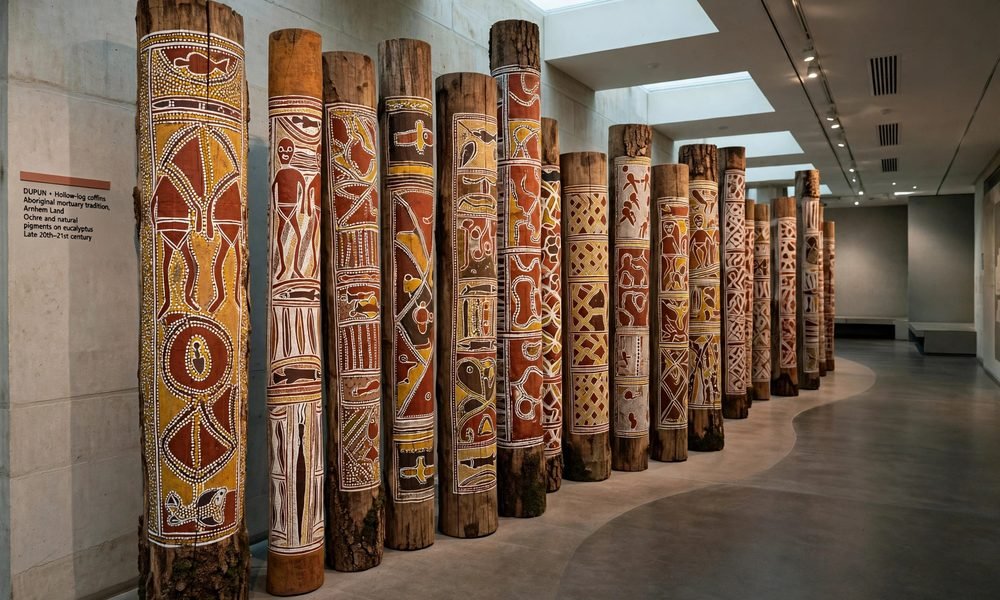
Start here. Two hundred dupun, hollow log coffins, stand in a winding path at the centre of the building. They were made by 43 artists from nine clans of Ramingining in Central Arnhem Land for the 1988 Bicentenary, one log for each year since British settlement began in 1788. The work honours the First Nations people who lost their lives defending their land. The Gallery calls it the heart of the building, and the description fits. Walk through slowly. It is quiet, and it stays with you.
Blue Poles by Jackson Pollock
Blue Poles (1952) is the best-known single painting in the building, and the most debated art purchase in Australian history. The Gallery bought it in 1973 for A$1.3 million, and the price caused a public outcry. Decades later it is a national treasure, valued at $500 million in 2023. The canvas is nearly five metres wide, so stand back first, then move in close to see the layers of dripped paint, glass shards and aluminium paint. Come at opening time or in the last hour of the day if you want it to yourself. The Gallery runs a research project on the painting called Action/Reaction, which you can explore on the Blue Poles research site.
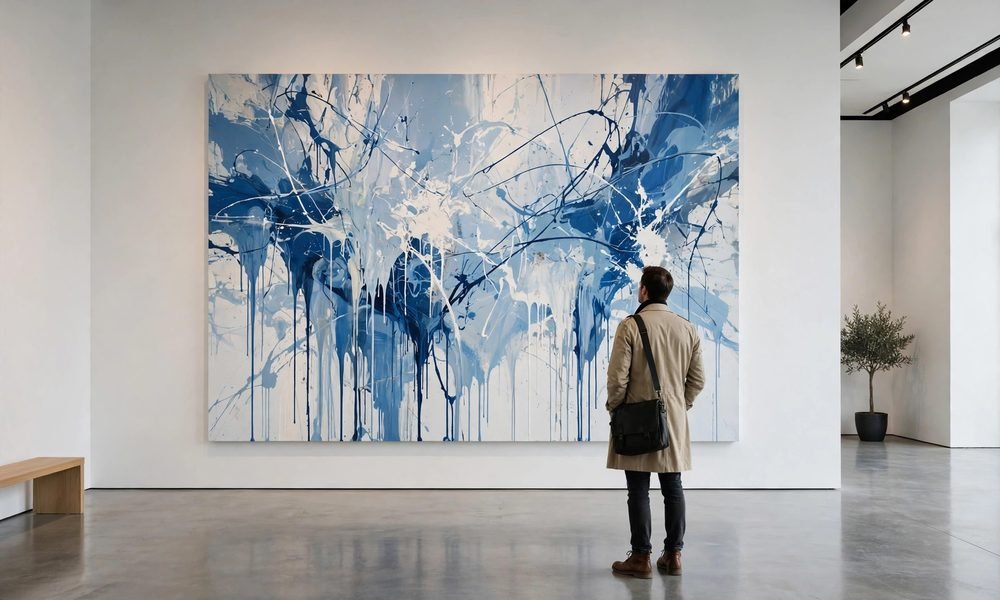
See Blue Poles before it leaves for Perth
Blue Poles leaves Canberra in 2027. It goes on display at the Art Gallery of Western Australia in Perth from 30 April to 5 September 2027, with free entry, then travels to Newcastle Art Gallery from 4 February to 30 April 2028. It is the first time the painting has been loaned to an Australian venue since 2003, and the first time it has ever been seen in Western Australia. The loan is part of the federal Sharing the National Collection program, and the Gallery is using the move to keep the painting on view while building works continue in Canberra. If Blue Poles tops your list, visit before April 2027.
Sidney Nolan’s Ned Kelly series
Nolan painted his bushranger series in 1946–47, and the stark black helmet against empty landscapes has become one of Australia’s best-known images. The Gallery holds 25 of the 27 paintings, a gift from Sunday Reed in 1977. Even if you have seen the helmet reproduced a thousand times, the real paintings land differently. They are blunt, dark, and oddly funny in places. Give them ten minutes. Look for The Trial and Stringybark Creek among the group.
The Sculpture Garden
The garden sits between the building and the lake, and it is worth an hour on its own. Around 30 works by Australian and international artists sit among native trees, lawns and water features. Look for Auguste Rodin’s bronze cast of The Burghers of Calais, Henry Moore’s Hill Arches and Bert Flugelman’s Cones. The newest landmark is Lindy Lee’s Ouroboros (2024), a four-metre, 13-tonne stainless-steel sculpture of a snake eating its own tail, made from recycled material and reported as the most expensive public artwork ever commissioned in Australia.
James Turrell’s Within Without (2010) stands in the Australian Garden on the south side of the building. It is a walk-in skyspace with a domed chamber open to the sky, at its most dramatic at dawn and dusk. It is open daily from sunrise to sunset, with no booking needed. Arrive about five minutes before dawn or dusk for the best effect. The work opens 30 minutes before dawn and closes 30 minutes after the dusk cycle, and only four people can be inside at once.
Heads up for 2026: the Gallery’s Capital Works Program is underway, and some garden works are off display. Fujiko Nakaya’s fog sculpture, Foggy wake in a desert, is closed for maintenance until around mid-2027. Fiona Hall’s Fern Garden is closed for significant rectification, and the Sculpture Garden Pavilion is closed, with a new pavilion due to open in 2028. Check the current closures on the Gallery’s visit page before you go. Even with the closures, the garden is a lovely walk.
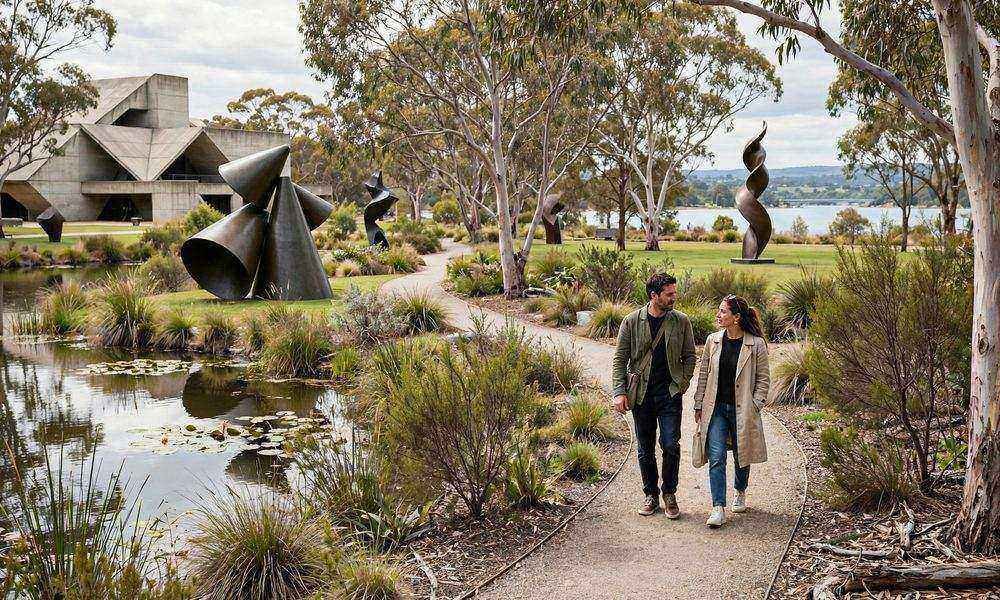
First Nations and Australian art
This is the deepest collection in the building. The Gallery holds the world’s largest collection of Aboriginal and Torres Strait Islander art, with more than 7,500 works in the holding and around 600 on display at any time. Eleven galleries dedicated to this collection opened in 2010, the first in Australia purpose-built for it. Look for bark paintings from Yirrkala in northeast Arnhem Land. These are documents of law and land stories, not decoration, and they sit close to the Yolngu people’s fight for land rights in the mid-20th century.
Clifford Possum Tjapaltjarri’s Warlugulong (1977) is one of the most important Indigenous paintings ever made, though it is not always on show. At around 3.4 metres long, it brings together several Dreaming stories connected to the artist’s ancestral Country. It sold at auction in 2007 for $2.4 million, then a record price for Indigenous Australian art. The photography collection is strong too, with staged, film-like works by Tracey Moffatt and low-light images by Bill Henson.
International and Asian art
The Gallery does not lead with its European art, but it is better than most visitors expect. The international galleries on Level 1 hold works by Monet, Degas, Cézanne and Picasso, plus Russian avant-garde, Dada and Surrealist pieces. Cézanne’s L’Après-midi à Naples (1875) is one of the most famous European paintings in the building, and Lucian Freud’s After Cézanne (1999–2000) hangs as a direct reply to it. The Gallery owns a complete set of Picasso’s 100 Vollard Suite etchings, one of only a few complete sets in the world. David Hockney’s A Bigger Grand Canyon and Russell Drysdale’s The Drover’s Wife are also worth seeking out.
The Asian and Pacific collection sits in the lower-level galleries, including the glass-walled Water Gallery, which looks out through the building’s concrete piers to a pond and bushland. The collection covers textiles, ceramics, bronzes and sculpture from South and Southeast Asia and the Pacific. The Gallery has spent a decade researching the history of these purchases, and it has returned looted Asian antiquities to India in 2014, 2016, 2019 and 2021.
Know My Name
Know My Name is the Gallery’s long-running initiative to rehang and research women artists who were overlooked by earlier collecting. The current display, Know My Name: Global, runs in Gallery 11 on Level 1 until 18 April 2027 and brings together women artists from around the world. It is a good second stop after the Australian galleries, because it changes how the rest of the collection reads.
The building itself
The Gallery was announced in 1967 by Prime Minister Harold Holt, designed by architect Col Madigan and the firm Edwards Madigan Torzillo and Partners, and built on the southern shore of Lake Burley Griffin. Construction began in 1973 and finished in 1981. Queen Elizabeth II formally opened the building on 12 October 1982. It is late-20th-century Brutalism: big bush-hammered concrete forms, angular geometry, and galleries that spiral across three floors from soaring top-lit rooms down to small, quiet spaces. Look up now and then. The coffered concrete ceilings in the international galleries are part of the experience. The building is heritage listed, which is one reason the current building works are happening.
The Capital Works Program runs from 2026 to 2030. The Gallery stays open through the works, but some galleries are closed for construction at any time, and the display space is smaller than usual. Exhibitions on site still cover highlights from the collection, and works also travel around the country through the Sharing the National Collection program.
Opening hours and tickets
The Gallery opens every day from 10am to 5pm. It closes only on Christmas Day. General admission is free, and that includes the Sculpture Garden. Major special exhibitions are ticketed and priced separately, so check what is on and book ahead, especially for big summer shows.
Parking is in the main underground car park (P1), which opens off Parkes Place from King Edward Terrace. Payment is by card only. Rates are listed on the Gallery’s visit page:
| Time parked | Rate |
|---|---|
| 0–1 hour | $4 |
| 1–2 hours | $8 |
| 2–3 hours | $12 |
| 3–4 hours | $16 |
| 4–5 hours | $20 |
| 7+ hours | $32 |
| Weekends and public holidays | $5 flat rate |
| Weekdays after 5pm | Free |
Mobility parking is free in both car parks. Rates can change, so check the official visit page before you go.
How long to spend and smart routes
Give yourself at least two hours for the highlights, and three to four if you like reading labels. Half a day lets you do the garden too. Here is one way to split it:
- One hour, greatest hits: Aboriginal Memorial, a quick pass through the Australian galleries, Blue Poles, then a short loop of the Sculpture Garden.
- Two to three hours, the full sweep: Add the international galleries, the First Nations rooms and the photography displays, plus the current special exhibition if one is on.
- Half a day, precinct day: Morning in the Gallery, lunch, then a walk along the lake to the National Portrait Gallery next door or across to the High Court. All of it is free and within easy walking distance.
Quieter times are usually mid-morning on weekdays and the last hour before closing. If you want Blue Poles to yourself, aim for opening time or the last hour of the day.
For a second free day, pair the Gallery with the Australian War Memorial and the National Museum of Australia, or work through the free things to do in Canberra guide.
Getting there and parking
The address is Parkes Place East, Parkes ACT 2600, in the Parliamentary Triangle between the National Portrait Gallery and the High Court. Bus routes 2 and 6 run from the city via Barton. Hop off at the John Gorton Building stop on Parkes Place and walk about six minutes. Cycling is easy too, with the lake paths running right past the garden. If you are coming from Parliament House, it is a flat lakeside walk past the High Court. Taxis and rideshares drop you at the main entrance on Parkes Place, off King Edward Terrace.
Where to eat and drink
Food options at the Gallery have been shifting during the building works, so treat this as a starting point and check the dining page before you visit. The Street Cafe serves fresh seasonal salads, sandwiches, sweet and savoury snacks and ONA coffee. It opens Monday to Friday from 9am to 2:30pm, and Saturday and Sunday from 9:30am to 2:30pm. The Dining Room, run by Kitchen by Mike, serves a seasonal lunch menu daily from 11am to 3pm on the lower ground floor, overlooking the Sculpture Garden.
The lakefront lawns are made for picnics. Grab supplies in Civic or at the Kingston foreshore and eat outside between galleries. There is no food or drink allowed in the gallery spaces themselves, though bottled water is fine in the foyer areas. The Gallery accepts contactless payments only, no cash.
Visiting with kids
This is one of the better Canberra stops for families. Entry is free, the galleries are wide and pram friendly, and kids’ programs run during peak seasons with hands-on activities. Pick up a family trail from the Family Desk on arrival. There is a Parents Room on Level 1, and nursing is welcome anywhere in the building. Strollers are free to borrow from the Concierge desk. Soft fabric baby carriers are welcome, but framed baby back carriers are not permitted, to protect the art. The Ned Kelly helmets and the Sculpture Garden are usually the biggest hits with young ones, and the hands-on studio space for the Rosalie Gascoigne exhibition runs daily from 10am to 5pm until 14 February 2027.
Free tours and programs
Free daily collection tours run at 11:30am and 2pm, led by Gallery guides. The Icons Tour runs on Mondays and Fridays at 1:30pm. Exhibition tours for Rosalie Gascoigne run daily at 3pm until 14 February 2027, and Full Throttle tours run daily at 10:30am and 1pm from 7 December 2026. These tours are free, and the guides know the stories behind the works.
For school groups, bookings are essential. Contact the Gallery on +61 2 6240 6777 or groupbookings@nga.gov.au. The Gallery also runs public programs, lectures and workshops through the year, plus Auslan-interpreted and audio-description tours each month, and Art for Wellbeing and Art and Dementia programs by request.
Accessibility at the Gallery
The Gallery is step-free, with lifts to every level. Wheelchairs, motorised scooters, walkers and canes are free to borrow from the Concierge desk. Book ahead by phone or email if you can. Large-print booklets are available for major exhibitions, and the Companion Card is honoured. Assistance animals are welcome. Quiet spaces and sensory-friendly resources are available on request — ask a staff member.
One exception: James Turrell’s Within Without does not comply with Australian access standards. Its ramps and walkways have open sides and no handrails, and the lighting inside is very low at night and before dawn. If you need help with access, contact Gallery staff on +61 2 6240 6411.
Entry rules and practical details
A few rules worth knowing so you do not get caught out at the door:
- Personal photography is welcome in most of the collection, but no flash, tripods, selfie sticks or extra lighting. Some exhibitions ban photography completely, so follow the signs.
- Bags or items bigger than a 30cm cube must be cloaked. Use the free self-service lockers in the Art Store. Smaller bags go under your arm or in front of you.
- Stay at least one metre from the art, and do not touch anything. Even clean hands damage surfaces.
- No smoking or vaping anywhere on the premises, including the garden.
- Free Wi-Fi runs throughout the building. Charging stations sit in the Art Store seating area.
- The Sculpture Garden stays open every day, even when the galleries themselves are closed.
FAQs about visiting the National Gallery
Is entry to the National Gallery of Australia really free?
Yes. The permanent collection and the Sculpture Garden are free for everyone. Only some major special exhibitions charge, and those prices change with each show. The next major exhibition, Full Throttle, opens on 5 December 2026 — check the Gallery’s what’s-on page for its ticket details. The Rosalie Gascoigne exhibition on now is free.
What is on at the National Gallery now?
Rosalie Gascoigne runs to 14 February 2027, along with Blossom: Country in bloom, David Hockney: Portraits in Print, Know My Name: Global and Body Adorned. Full Throttle, the next major exhibition, opens on 5 December 2026 and runs to 11 April 2027. The permanent collection — the Aboriginal Memorial, Blue Poles, the Ned Kelly series and the Sculpture Garden — is on display all year, apart from works closed for the building program.
Is the Skyspace (Within Without) open?
Yes. James Turrell’s Within Without is open daily from sunrise to sunset in the Australian Garden, with no booking needed. It is at its best at dawn and dusk, so arrive about five minutes before the cycle starts. It opens 30 minutes before dawn and closes 30 minutes after the dusk cycle, and only four people can be inside at once. It is closed on Christmas Day, like the rest of the Gallery.
When does Blue Poles leave Canberra?
Blue Poles goes on display at the Art Gallery of Western Australia in Perth from 30 April to 5 September 2027, with free entry, then travels to Newcastle Art Gallery from 4 February to 30 April 2028. It is the first time the painting has been loaned to an Australian venue since 2003. See it in Canberra before April 2027 if you want to catch it at home.
How long should you spend at the National Gallery?
Two to three hours covers the highlights, including the Aboriginal Memorial, Blue Poles and the Ned Kelly series. Add an hour for the eleven Aboriginal and Torres Strait Islander Art galleries, and another hour for the Sculpture Garden. Entry is free, so you can leave for lunch by the lake and come back for the afternoon galleries. The Sculpture Garden stays open even when the galleries are closed, so it works as a dawn or dusk stop too.
Plan your visit to the National Gallery
It is free, it holds the country’s national art collection, and it sits on the shore of Lake Burley Griffin. The Aboriginal Memorial alone justifies the trip, Blue Poles is worth seeing in person at least once — and soon, before it leaves for Perth — and the garden gives you a reason to slow down. Allow two to four hours, pair it with a lake walk and the neighbouring galleries, and you have a full free day in the capital. Put it at the top of your things to do in Canberra list.